
Quick Answer
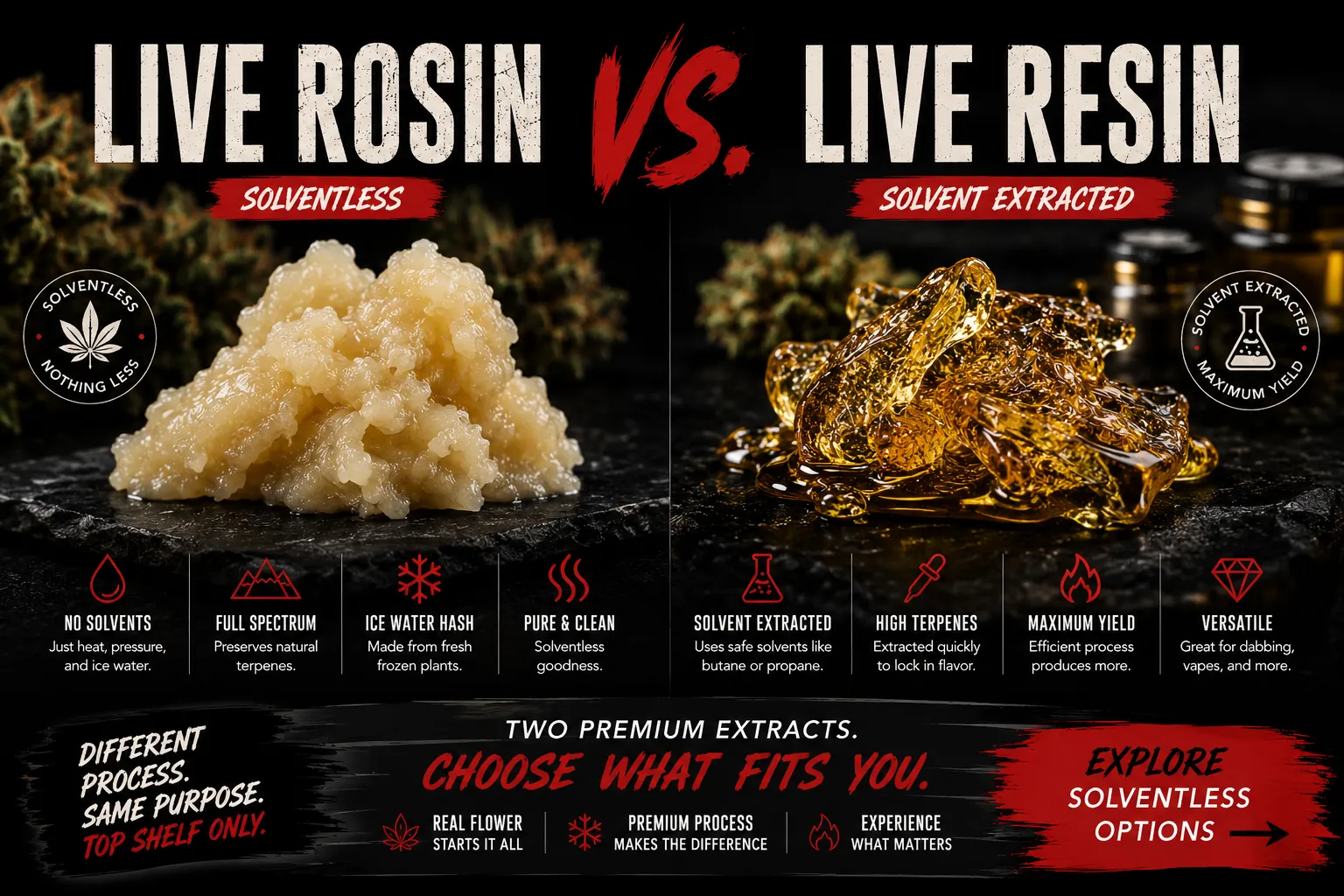
The core difference is extraction: live rosin is solventless — pressed from ice-water hash using only heat and pressure — while live resin is extracted with chemical solvents, typically butane, which are then purged from the final product. Both start from fresh-frozen cannabis, which is what “live” means, and both preserve strong terpene profiles. Rosin is the craft, mechanical route; resin is the industrial, chemical route. That single production difference drives everything else: price, flavor character, and who each format is built for.
One letter apart, two different philosophies. Here’s the full comparison.
Skip ahead and explore solventless options → firebreathersca.com
Live Rosin vs. Live Resin: Full Comparison Table
| Factor | Live Rosin | Live Resin |
|---|---|---|
| Extraction | Solventless — ice water, heat, pressure | Solvent-based — butane/propane wash, then purged |
| Starting material | Fresh-frozen flower → ice-water hash | Fresh-frozen flower |
| What “live” means | Same for both: plants frozen at harvest, never dried | Same for both |
| Terpene preservation | Full trichome contents, mechanically intact | Strong, though solvent contact and purging can alter delicate compounds |
| Consistency | Badder, jam, fresh-press sap | Sauce, sugar, badder, diamonds |
| Processing | Mechanical separation only | Chemical extraction + vacuum purge |
| Residual solvents | None possible — never used | Must be purged and lab-verified below safety limits |
| Price | Higher — labor-intensive, low-yield | Lower — scalable, high-yield |
| Typical formats | Jarred rosin, rosin carts, rosin gummies | Jarred resin, resin carts, infused pre-rolls |
How Live Rosin Is Made
Live rosin is a two-step mechanical process:
- Fresh-frozen flower is washed into ice-water hash. Whole plants are frozen at harvest — skipping drying and curing entirely — locking in the volatile terpenes that normally evaporate. The frozen material is agitated in ice water so the brittle trichome heads snap off, then collected in fine mesh bags and dried into bubble hash.
- The hash is pressed. Between heated plates at moderate temperatures, the trichomes rupture and release their oil. That oil is live rosin — collected, jarred, and usually cold-cured.
No chemicals touch the product at any point. The full walkthrough lives here: What Is Hash Rosin?
How Live Resin Is Made
Live resin starts with the same fresh-frozen advantage, then diverges:
- Frozen plant material is loaded into a closed-loop extraction system.
- Chilled butane (or a butane-propane blend) washes over it, dissolving cannabinoids and terpenes out of the plant.
- The solvent is boiled off and vacuum-purged at low temperatures, leaving the concentrated extract behind.
- The extract is finished into sauce, sugar, badder, or diamond formats.
Done well — cold temperatures, quality equipment, thorough purging — live resin is a legitimate, flavorful product that tests clean for residual solvents. The fresh-frozen starting material is why it eats older extraction styles like shatter for flavor.
Where the Experience Actually Differs
Flavor and aroma
Both formats are terpene-forward — that’s the point of “live.” The difference is character. Rosin tastes like the strain, unfiltered: the full, intact contents of the trichome, nothing subtracted. Resin flavor is strong but has passed through a chemical solvent and a purge cycle, which can shift the profile’s nuance. Side by side on the same strain, most experienced palates can tell them apart.
Consistency and handling
Rosin trends toward badders and jams — soft, scoopable, cold-stored. Resin offers more variety, including “diamonds and sauce” — THCA crystals swimming in terpene liquid — which some users specifically seek out.
The product experience
Practically, both dab the same and vape the same. The differences a shopper feels are flavor character, price on the shelf, and what’s on the lab report. Neither format is objectively “stronger” — potency depends on the starting flower and the specific batch, not the extraction method.
Choose Rosin When… / Choose Resin When…
Choose live rosin when:
- Flavor fidelity is your top priority — you want the strain, not an interpretation of it
- You prefer a product where residual solvents are structurally impossible, not just lab-verified
- You’re buying premium and want the craft, small-batch tier
- Ingredient simplicity matters to you — one input, zero chemicals
Choose live resin when:
- Budget is a bigger factor — resin delivers strong flavor at a lower price point
- You want diamonds-and-sauce or other resin-specific textures
- Availability wins — resin’s scalability means wider selection in many markets
- You’ve verified the COA shows passing residual-solvent results
Neither answer is wrong. They’re different tools at different price points — the honest framing is craft versus scale, not good versus bad.
Quality Signals (Whichever You Choose)
Extraction method doesn’t excuse bad sourcing. Check for these regardless:
- Named, single-strain source material — “blend” usually means leftovers
- Fresh-frozen confirmed — “live” should be verifiable, not decorative
- Full COA — cannabinoids, terpenes if available, contaminants, and (for resin) residual solvents
- Cold-chain handling — terpene products degrade warm
- Real color and aroma — light color, loud smell; dark and faint means old or dirty material
Same rules as every other format — the full checklist is in How to Choose THCA Products.
Where Fire Breathers Stands
We’re a solventless house. Not because live resin can’t be made well — it can — but because our entire brand is built on subtraction: no bulk outdoor, no mids, no shortcuts, and no chemicals between the plant and the jar. Every Fire Breathers concentrate is pressed from craft California flower — ice water, heat, pressure, done.
- Small Batch. Big Flavor. Pressed to perfection.
- 100% solventless — rosin, rosin vapes, rosin gummies
- Third-party lab tested — COAs on request, federally compliant
- Free shipping over $40 to most U.S. states
Frequently Asked Questions
Is live rosin stronger than live resin?
Not inherently. Both typically test between 60–85% total cannabinoids depending on the batch and finish. Potency comes from the starting material and process quality, not the extraction category.
Why is live rosin more expensive?
Yield and labor. Ice-water hash washing is slow, manual, and only the best trichome heads make the cut — a fraction of the plant becomes rosin. Closed-loop solvent extraction pulls far more product per pound of flower with far less labor.
Is live resin safe to consume?
Properly made and lab-tested live resin purges to residual-solvent levels far below safety limits. The COA is your verification — never buy resin from a vendor who won’t show passing residual-solvent results.
Can I use both?
Plenty of concentrate users do — rosin for flavor-first sessions, resin where price or selection favors it. They dab and vape identically; keep your dose consistent and store both cold.
Is rosin or resin better for vapes?
Rosin carts deliver the truest strain flavor and are the premium tier; resin carts are a step up from distillate at a mid-range price. Either beats a mystery-oil cart — see What Is a THCA Vape? for the full vape breakdown.
The Bottom Line
Live rosin and live resin both start from fresh-frozen cannabis and both chase the same thing: the flavor of the living plant. The fork in the road is how they get there — mechanical separation versus chemical extraction. Rosin is the craft lane. Resin is the scale lane.
Decide what you’re paying for, verify the lab work, and buy from someone who tells you exactly how the jar got made.
Shop Fire Breathers Solventless — Small Batch. Big Flavor. →
Fire Breathers products are intended for adults 21 and older. Federally compliant hemp under the 2018 Farm Bill. Comply with all applicable state and local laws. Do not operate machinery while under the influence. Educational content — not medical or legal advice.