Quick Answer
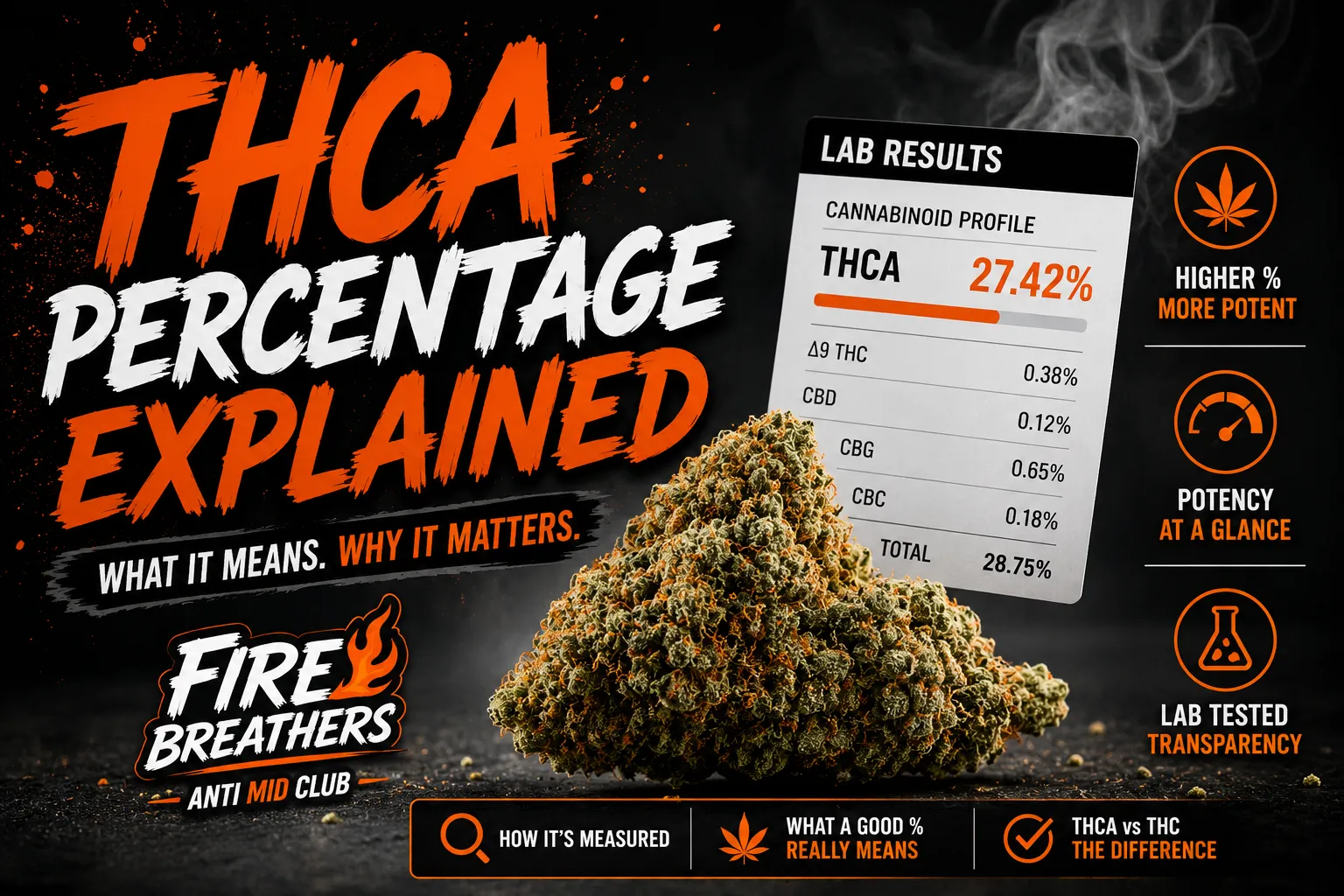
A “good” THCA percentage in modern craft hemp flower lands between roughly 20% and 30%, with truly premium small-batch indoor frequently testing 25–32%. Anything below ~18% is generally considered mid-shelf or outdoor-grown. Anything advertised above 35% is either an extreme outlier, an extract-infused “moon rock”–style product, or — more often — a labeling exaggeration. But here’s the part most shoppers miss: THCA percentage alone is a weak predictor of how good a flower actually smokes. Terpene profile, cultivation method, freshness, and the broader cannabinoid spectrum matter more than chasing the highest number on the jar.
That’s the short version. Below is the full breakdown — what THCA percentage actually measures, what “total THC” means on a COA, the realistic potency tiers in 2026, why the highest number isn’t always the best flower, and how to read a lab report like someone who actually knows what they’re buying.
Want craft 20–28% small-batch flower? → Shop Fire Breathers
The Quick Breakdown
| Question | Answer |
|---|---|
| What is THCA percentage? | The amount of tetrahydrocannabinolic acid in the flower by weight, shown on the Certificate of Analysis (COA). |
| What’s “average”? | ~18–22% for typical indoor THCA hemp flower in 2026. |
| What’s “premium”? | ~22–28%. The connoisseur band where craft indoor lives. |
| What’s “high”? | ~28–32%. Rare top-shelf phenos, fresh harvest, ideal cure. |
| What’s “suspicious”? | 35%+. Almost always an outlier, an infused product, or exaggeration. |
| Is higher always better? | No. Terpenes and craft matter more than the number. |
| What does “total THC” mean? | THCA × 0.877 + Delta-9 THC. This is the active potency after heat. |
What Does THCA Percentage Actually Measure?
When you look at a COA and see “THCA: 26.4%,” that number is telling you what percentage of the flower’s total dry weight is tetrahydrocannabinolic acid — the raw, non-intoxicating precursor to THC. (For a refresher on what THCA is and how it converts to THC, see our What Is THCA? guide.)
In a 1-gram nug testing at 26.4% THCA, that’s roughly 264 milligrams of THCA in the bud. Once you apply heat — through smoking, vaping, or dabbing — that THCA converts to Delta-9 THC, minus a small amount lost as CO₂ during the chemical conversion.
So when you compare two flowers — one at 18% THCA and one at 28% THCA — you are, in fact, comparing two different potencies. But potency isn’t the only thing that determines how good a flower actually smokes, and treating it as such is the single most common shopper mistake in the THCA market.
”Total THC” vs. THCA — Decoding the COA Math
When a flower is tested, the lab reports two key numbers:
- THCA — the raw cannabinoid in the unheated flower
- Delta-9 THC — the small amount of already-active THC present at the time of testing
But the effective potency you’ll actually experience when you smoke or vape comes from total THC, calculated like this:
Total THC = (THCA × 0.877) + Delta-9 THC
That 0.877 multiplier reflects the molecular weight lost (as CO₂) during decarboxylation. Two THCA molecules don’t become two THC molecules — they become 0.877 of two THC molecules.
Worked Example
A flower tests at:
- THCA: 27.0%
- Delta-9 THC: 0.2%
Total THC = (27.0 × 0.877) + 0.2 = 23.9%
That’s the number that actually matters for the smoke. The 27% on the front of the jar is the raw cannabinoid content — the 23.9% is what you’ll feel.
Why this matters for buying: Some vendors prominently display the THCA number because it’s bigger. The honest number is total THC. A premium COA shows both, calculates total THC, and explains the difference.
The Realistic THCA Percentage Tiers (2026)
Here’s the actual quality landscape in the 2026 THCA market, based on what consistently shows up on real third-party COAs:
Bottom Shelf — Under 18% THCA
- What it usually is: Outdoor bulk, older harvest, poor genetics, or fluffed-up trim
- Smokes like: Harsh, weak, often grassy or hay-flavored
- Price tier: Sub-$20/eighth
- Skip if: You care about flavor, smoothness, or terpene expression
Mid Shelf — 18–22% THCA
- What it usually is: Decent indoor or strong outdoor, average craft
- Smokes like: Solid, functional, decent terps if fresh
- Price tier: $20–$30/eighth
- Good for: Everyday smoking on a budget, party flower, joints in rotation
Top Shelf — 22–28% THCA
- What it usually is: Real craft indoor, small batch, hand-trimmed, modern genetics
- Smokes like: Loud nose on jar-open, rich flavor, strong but balanced effect
- Price tier: $30–$50/eighth ← this is Fire Breathers’ core range
- Best for: Connoisseurs, daily users who care about quality, gift-grade flower
Connoisseur — 28–32% THCA
- What it usually is: Elite phenos, fresh-cut harvest, ideal cure, often limited drops
- Smokes like: Exceptional — terpene complexity, fast onset, full effect
- Price tier: $50+/eighth
- Best for: Special occasions, tasting flights, rare strain hunting
Suspicious — 35%+ THCA on Pure Flower
- What it usually is: Either an infused/moon-rock product (rosin-coated), a hand-picked outlier nug, or a labeling exaggeration
- The reality: Naturally occurring THCA flower above ~32% is genuinely rare. Most “40% THCA” claims do not survive independent testing.
- The verdict: Be skeptical. Ask for the third-party COA on the specific batch, not a marketing brochure.
Why THCA Percentage Isn’t the Whole Story
This is the part the bulk-grower side of the market doesn’t want you to think about: the highest THCA percentage is rarely the best smoke.
Three reasons:
1. Terpenes Drive the Experience
Terpenes are the aromatic compounds that give each strain its distinct smell, flavor, and effect character. Limonene (citrus, energizing), myrcene (earthy, sedating), caryophyllene (peppery, soothing), pinene (pine, focusing) — these compounds shape what the high actually feels like.
A flower at 22% THCA with a rich, expressive terpene profile (2.5%+ total terpenes) will out-smoke a 30% flower with no nose every time. The 30% may technically be “stronger,” but the 22% will be the one you remember.
2. Cannabinoid Spectrum Matters
A premium COA shows more than just THCA. It includes:
- CBG — non-intoxicating, often associated with smoother sessions
- CBN — produced as THC ages, contributes to body effect
- CBD — modulates THC’s intensity
- THCV — unique character, varies by strain
The entourage effect — the idea that cannabinoids and terpenes work together — explains why a balanced 24% THCA flower often feels better than a one-note 30% flower stripped of supporting compounds.
3. Cultivation Quality Trumps Numbers
A 28% flower grown badly — flushed wrong, cured too fast, machine-trimmed, packed humid — is going to smoke worse than a 23% flower from a craft grower who knows what they’re doing. Numbers measure chemistry. Smoke quality measures craft.
This is the core argument behind Fire Breathers’ positioning: small batch, big flavor. We chase quality, not the biggest number on the jar.
How to Read a THCA COA Like a Pro
A real third-party COA — the kind every reputable vendor should provide on request — contains far more than a single THCA number. Here’s what to actually look at:
Cannabinoid Profile
- THCA percentage — main potency driver
- Delta-9 THC — should be ≤0.3% for federal hemp compliance
- Total THC — the calculated effective potency
- CBG, CBN, CBD, THCV — minor cannabinoids that round out the experience
Terpene Profile (Bonus — Not All Labs Include)
- Total terpene percentage — 2%+ is strong, 3%+ is exceptional
- Dominant terpenes — should match the strain character (lemony strains = limonene, etc.)
Contaminant Screening
- Pesticides — should show “Pass” or “ND” (non-detect) for all
- Heavy metals — same standard
- Microbials & mycotoxins — same standard
- Residual solvents — should be N/A for flower (relevant for extracts)
Batch & Date Information
- Batch ID — should match what’s on the product packaging
- Harvest date — fresher is better (under 6 months is ideal)
- Test date — should be reasonably recent
- Lab name and accreditation — ISO 17025 accredited is the standard
Red Flags on a COA
- No batch ID match
- Test date older than 12 months
- Missing contaminant panels
- Delta-9 above 0.3% (federal compliance failure)
- Lab name and logo unverifiable online
- “Sample provided by vendor” with no chain-of-custody info
”What’s the Strongest THCA Flower I Can Buy?”
The honest answer is roughly 30–32% on a real, third-party COA from a reputable craft grower. Beyond that, you’re in the territory of:
- Infused flower / “moon rocks” — rosin or distillate-coated buds that can technically hit 50%+, but they’re an enhanced product, not pure flower.
- Hash rosin & concentrates — solventless extracts can reach 70–85% total cannabinoids. If you want maximum potency, that’s the format, not flower.
- THCA isolate — 95%+ pure THCA crystals. Niche product, not a flower.
For raw, unenhanced flower, the “strongest” question is the wrong question. The right question is: what’s the best smoke I can buy for my dollar? That answer is almost always a 24–28% craft indoor flower with a loud terpene profile — not a heavily marketed “35%” claim.
”What’s the Lowest THCA Percentage Still Worth Buying?”
If a flower is in the 18–22% range but comes from a quality grower with a strong terpene profile and a clean COA — yes, absolutely worth buying. Some classic genetics (especially older landrace-leaning strains) simply don’t hit modern hybrid numbers but smoke beautifully.
Below 18%, you’re usually looking at:
- Outdoor or greenhouse bulk
- Older harvest with degraded cannabinoids
- Light-deprivation grows that didn’t finish
- Mid-grade trim being sold as flower
It can still be smokeable. It’s just rarely worth the shipping cost vs. spending $5–$10 more for craft indoor.
Strain Type & Typical Percentage Ranges
| Strain Style | Typical THCA Range | Notes |
|---|---|---|
| Modern hybrids (White Runtz, Lemon Cherry Gelato, Zours) | 24–30% | The current sweet spot for craft indoor |
| Indica-dominant (Animal Cookies, Zkittles, Purple Punch) | 22–28% | Often more terpene-forward than peak potency |
| Sativa-dominant (Sour Diesel pheno, Lemon Cherry Gelato) | 20–26% | Slightly lower averages, but expressive terps |
| Classic OGs | 20–25% | Old-school genetics, rich character |
| Landrace / Heirloom | 14–22% | Lower numbers, exceptional smoke quality |
| Bred-for-potency phenos | 28–32% | The “show off” tier — fresh-press strains |
For Fire Breathers’ typical lineup of indoor California genetics, expect to see real-world testing in the 22–28% band — with the occasional fresh-harvest drop pushing into 29–30% territory.
How to Match THCA Percentage to Your Tolerance
| Experience Level | Recommended Starting Range | Notes |
|---|---|---|
| Beginner (first-timer, returning user) | 18–22% | Lower numbers = easier to dose, more forgiving |
| Intermediate (occasional smoker) | 22–26% | Sweet spot for most regular users |
| Experienced (regular smoker, established tolerance) | 24–30% | Where craft connoisseur flower lives |
| Concentrate-tolerant (dabbers, daily users) | 28%+ flower, or jump to hash rosin | Diminishing returns above 30% on raw flower |
A common mistake: a beginner buys a 30% flower because “stronger sounds better,” over-greens themselves, and decides cannabis isn’t for them. Start lower than you think you need — you can always smoke more, you can’t smoke less.
For a deeper breakdown by experience level, see How to Choose THCA Products.
The “Total THC Compliance” Trap
A quick technical note worth knowing — especially heading into late 2026:
Under the current 2018 Farm Bill, federal hemp compliance is judged on Delta-9 THC (≤0.3%). Most premium THCA flower passes this test easily because its Delta-9 stays under 0.3% even though its THCA might be 25%+.
However, the November 12, 2026 federal rule change is expected to redefine hemp using total THC — which would include THCA in the calculation. Under that math, virtually all current THCA flower would exceed the federal hemp limit.
Translation: The THCA percentage on the jar is the same number that may soon disqualify the product from federal hemp protection. The legal lane the market currently runs on is closing. (Full context in our Is THCA Legal? guide.)
If access matters, the practical window is now.
Why Fire Breathers Doesn’t Chase the Biggest Number
We could juice our marketing with “35% THCA!” claims. Most of the market does. Here’s why we don’t:
- Inflated numbers attract refunds. A buyer expecting 35% who gets a real 24% feels cheated — even if the 24% is exceptional.
- The connoisseur audience doesn’t fall for it. Real smokers know the smell, the burn, the ash, the resin — the chemistry on paper is just one signal.
- Quality is verifiable. Numbers can be gamed. Hand-trimmed buds, indoor cultivation, small-batch cure, real strain genetics — these survive scrutiny in ways inflated COA numbers do not.
Our flower consistently tests in the 22–28% range with strong terpene profiles (often 2–3%+), grown indoor in California, hand-trimmed, small-batch, and third-party tested every harvest. Pressed to perfection.
Browse the craft lineup → firebreathersca.com
Why Fire Breathers
If you’ve read this far, you already understand the difference between number on the jar and quality in the bag. That’s the customer Fire Breathers is built for.
- Small Batch. Big Flavor. — California craft indoor, no bulk outdoor
- 22–28% Real-World THCA — verified, not inflated
- No Shake. No Machines. — hand-trimmed, hand-rolled
- Third-Party COAs — every batch, available on request
- Free Shipping Over $40 — ships to most U.S. states
- Built for Connoisseurs — pressed to perfection
Frequently Asked Questions
What is a good THCA percentage in flower?
For modern craft indoor hemp flower, 22–28% is the realistic premium range in 2026. Anything 28–32% is exceptional. Below 18% is typically mid-shelf or outdoor.
What does THCA percentage mean on a COA?
It’s the percentage of the flower’s total dry weight that is tetrahydrocannabinolic acid — the raw, non-intoxicating precursor to Delta-9 THC. Once heated, the THCA converts to active THC.
Is higher THCA always better?
No. Terpene profile, cultivation method, freshness, and the broader cannabinoid spectrum often matter more than a few extra percentage points of THCA. A 24% craft flower frequently smokes better than a 30% bulk flower.
How do you calculate total THC from THCA?
Total THC = (THCA × 0.877) + Delta-9 THC. The 0.877 multiplier reflects the molecular weight lost as CO₂ during decarboxylation.
What’s the strongest THCA flower available?
Real, unenhanced craft flower tops out around 30–32% THCA in 2026. Higher claims are typically infused products, outliers, or marketing exaggerations. For maximum potency, hash rosin and concentrates are the better category.
What does 30% THCA mean in real terms?
A flower at 30% THCA, after heat, gives you roughly 26.5% effective THC by weight. In a 1-gram bowl, that’s about 265 mg of active THC available for inhalation (with bioavailability typically 10–35% of that reaching the bloodstream).
Why does my THCA flower test at 25% but feel stronger than dispensary 30% flower?
Likely because the THCA flower has a richer terpene profile, fresher harvest, better cultivation, or a fuller cannabinoid spectrum. Subjective “strength” is shaped by far more than the THCA number alone.
Is 40% THCA flower real?
Extremely rare on pure flower. Most claims at this level are either infused products (rosin-coated “moon rocks”), hand-selected outlier samples that don’t represent the batch, or labeling exaggerations. Treat with skepticism and ask for the third-party COA.
Does THCA percentage change over time?
Yes, slowly. As flower ages, THCA gradually converts to Delta-9 THC and then to CBN. Properly stored flower (cool, dark, sealed) holds its profile for 6–12 months. After that, expect terpene loss and potency drift.
What percentage is best for beginners?
18–22% THCA flower is the most forgiving for newer users. Easier to dose, easier to recover from, and still delivers a real experience. Save the 28%+ flower for after your tolerance settles.
The Bottom Line
THCA percentage matters — but not as much as the marketing suggests. 22–28% in real-world craft indoor flower is the connoisseur sweet spot. Beyond that, you’re paying for diminishing returns and chasing numbers that often don’t survive independent testing.
What actually separates great flower from average flower: terpene density, cultivation craft, harvest freshness, and a full cannabinoid spectrum. The number on the jar is a starting point. The smoke is the verdict.
Buy from growers who tell you what they grew, where they grew it, and what’s actually in it. Skip the ones flashing 40% claims with no COA to back it up.
Shop Fire Breathers — Real Numbers. Real Craft. Pressed to Perfection. →
Fire Breathers products are intended for adults 21 and older. Federally compliant hemp under the 2018 Farm Bill. Educational content — not medical advice. Comply with all applicable state and local laws. COA available on request for every batch.