Quick Answer
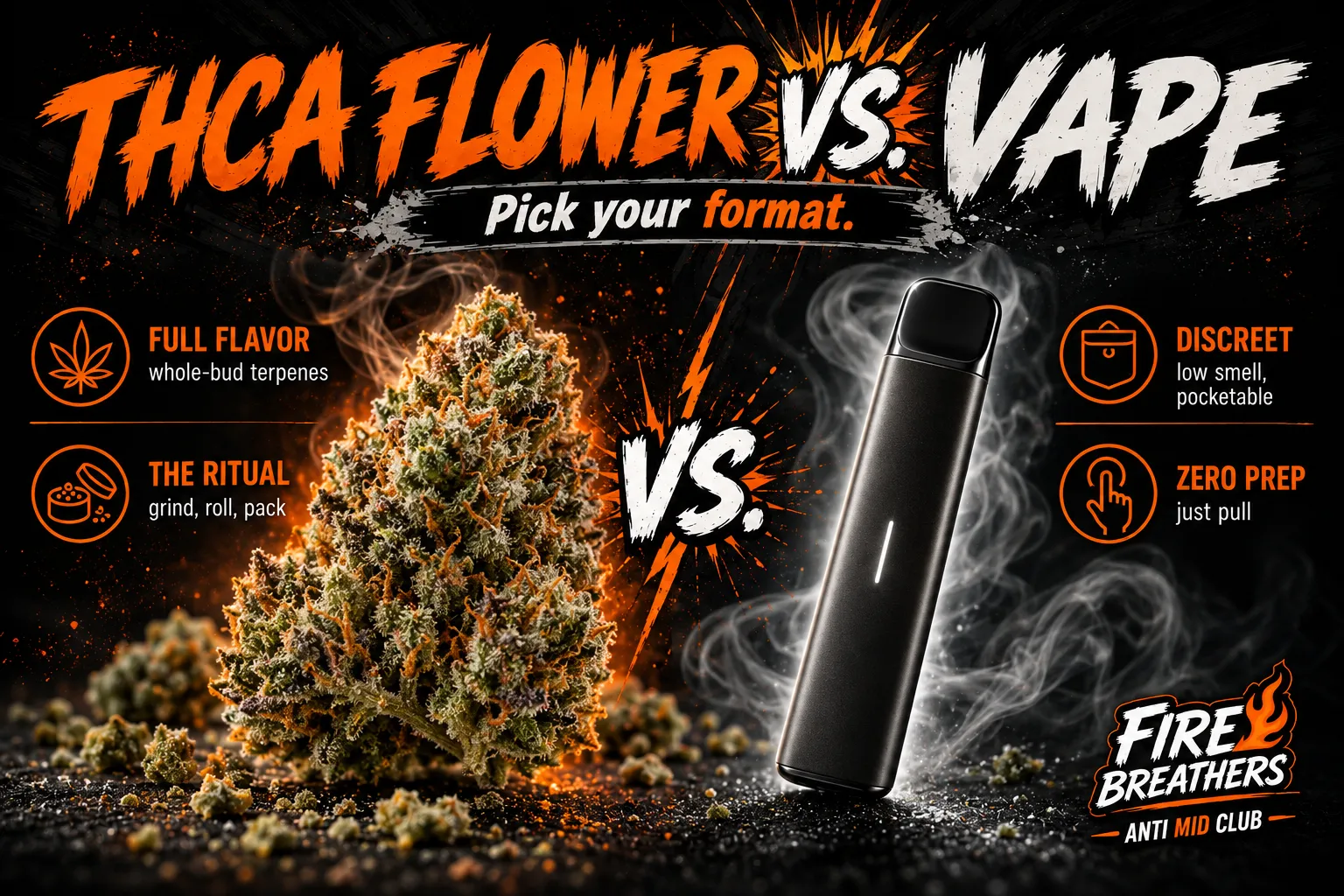
THCA flower and THCA vapes both turn THCA into Delta-9 THC with heat, so both deliver the full cannabis experience within minutes. Flower wins on flavor depth, ritual, and cost per gram. Vapes win on discretion, portability, and zero prep. Most regular users keep both: flower at home, a vape everywhere else.
Below: a full side-by-side table, the differences that actually matter, and a simple way to decide.
Shop both formats → firebreathersca.com
The Quick Breakdown
| What flower is | Whole, cured THCA-rich buds you grind and smoke or vape. |
|---|---|
| What a THCA vape is | A pen or cartridge filled with THCA-rich oil (rosin or distillate), heated by a coil. |
| What they share | Heat converts THCA to Delta-9 THC. Both act within minutes. |
| Flower’s edge | Full terpene expression, ritual, lower cost per gram. |
| Vape’s edge | Little smell, pocketable, no grinder or papers. |
| The verdict | Pick by setting, not by “strength.” |
The Full Comparison Table
| THCA Flower | THCA Vape | |
|---|---|---|
| How it works | Combustion (joint, bowl) or dry-herb vaporizer heats the bud | Battery heats a coil that vaporizes concentrated oil |
| Onset | Within minutes | Within minutes |
| Typical duration | 1–3 hours | 1–2 hours |
| Material potency | Craft indoor flower commonly tests around 20–30% THCA | Oil is far more concentrated, often 70–90% total cannabinoids |
| Per-session control | Good: take a hit, wait | Very good: short puffs are easy to measure |
| Flavor | Deepest and most complete, the reference point | High with rosin; flatter with commodity distillate |
| Smell | Strong. Smoke lingers in rooms and on clothes | Light and quick to fade |
| Discretion | Low | High |
| Prep and gear | Grinder, papers or glass, lighter | None with a disposable |
| Portability | Moderate. Needs a container and gear | Pocket-sized |
| Smoke | Yes, when combusted (none with a dry-herb vape) | No combustion |
| Cost | Lower cost per gram | Higher cost per gram of material, but less material per session |
| Variety | Easy to rotate strains by the eighth | One strain per device |
| Where it fits | Home, social sessions, slow evenings | Travel, apartments, short breaks |
What They Have in Common
The chemistry is the same. THCA is the raw, non-intoxicating precursor in cannabis. Heat converts it into Delta-9 THC through decarboxylation. A lighter does that. So does a vape coil. Either way, the THC reaches you within minutes. (Refresher: What Is THCA?)
That means the “which is stronger” debate is mostly a wash. Vape oil is more concentrated, but you control the dose by how long and how often you draw. Both formats show up on drug tests. Both fall under the same federal hemp framework. Legality is covered in Is THCA Legal?
Where Flower Wins
Flavor and aroma
Flower is the whole plant, with its full terpene profile intact. Open a jar and you get the strain’s aroma before you even light it. No extract fully reproduces that. If flavor is why you’re here, flower is the benchmark. Read more about how aroma compounds work in What Are Terpenes?
Ritual
Grinding, rolling, packing a bowl. For a lot of people, the process is part of the point. A vape is a button. Flower is a session.
Cost per gram and variety
Flower costs less per gram than vape oil, and it’s easy to rotate strains. At Fire Breathers, an eighth of flower like Permanent Marker THCA Flower is $30 for 3.5g, with 7g at $55 and 14g at $100. You can try three or four strains for the price of a few devices.
Freedom of method
Flower works in a joint, a bowl, a bong, or a dry-herb vaporizer. A dry-herb vape gives you no combustion while keeping the whole bud. See Best Smoking Devices for Flower for options.
Where the Vape Wins
Discretion
Vapor carries much less odor than smoke, and it fades fast. No smell on your jacket, no lingering haze in the apartment. If discretion matters, this is the deciding factor.
Zero prep
A disposable is ready out of the box. No grinder, no papers, no lighter. Pull, done.
Portability
A disposable fits in a pocket. Flower needs a container, a grinder, and a way to smoke it.
Easy micro-dosing
Short puffs make it simple to take a little and stop. That’s useful for lighter, shorter sessions.
The catch: what’s in the oil
A vape is only as good as its oil. Rosin vapes use solventless hash rosin pressed from real flower, so the flavor is the strain’s own. Distillate vapes use refined cannabinoids with flavor added back in. They’re cheaper and often taste flat. Fire Breathers disposables, like the Sour Diesel THCA Hash Rosin Disposable Vape .5g ($40), are made with 100% full-spectrum hash rosin. Full breakdown: What Is a THCA Vape?
Cost: How to Compare Fairly
Comparing price per gram is misleading, because vape oil is concentrated and a session uses far less of it. A fairer question is cost per session, and that depends on how you use each one.
- Flower: $30 buys 3.5g at Fire Breathers. A joint might use anywhere from a fraction of a gram to a full gram.
- Vape: $40 buys a .5g rosin disposable at Fire Breathers, with multi-unit pricing at 2 for $75 and 3 for $110. A short session might be a few puffs.
Heavy, social sessions usually favor flower. Short, solo sessions often favor a vape.
Health and Comfort Notes
This isn’t medical advice, but a few practical points:
- Combustion produces smoke. Some people choose vaporizing (oil or dry herb) because it avoids burning plant material.
- Hardware matters. Cheap vape hardware can affect flavor and quality. Look for ceramic coils and a vendor that publishes lab results.
- Lab testing matters for both. A COA should confirm potency and screen for contaminants. Learn the basics in How to Read a THCA COA.
Flower or Vape? How to Decide
| If you… | Choose |
|---|---|
| Care most about flavor and aroma | Flower |
| Enjoy the ritual of rolling or packing | Flower |
| Want the lowest cost per gram | Flower |
| Like trying lots of strains | Flower |
| Need low odor and discretion | Vape |
| Travel or live in shared space | Vape |
| Want zero prep and no gear | Vape |
| Prefer short, light sessions | Vape |
Honest answer: most experienced users don’t pick one. Flower is the main event at home. A vape covers everything else. Want to see all formats side by side? Read THCA Flower vs. Vapes vs. Concentrates vs. Edibles.
Why Fire Breathers for Both
We built both lines around the same idea: start with great flower and don’t cut corners after that.
- Small Batch. Big Flavor. Craft indoor California THCA flower, hand-trimmed, $30 per eighth
- Rosin, not distillate. Disposables made with 100% full-spectrum hash rosin, $40 per .5g
- Matching profiles. Some strains come in both formats, like Blue Zushi THCA Flower and the Blue Zushi THCA Hash Rosin Disposable Vape .5g
- Third-party lab tested. COAs available
- Free shipping over $40 to most U.S. states
Frequently Asked Questions
Is a THCA vape stronger than THCA flower?
The oil is more concentrated, often 70–90% total cannabinoids versus roughly 20–30% THCA in craft flower. But strength per session depends on how much you take. A short puff from a vape can be lighter than a full joint. Both deliver Delta-9 THC once heated, so neither is categorically stronger in practice.
Does vaping THCA smell less than smoking flower?
Yes. Vapor from an oil pen carries much less odor than smoke, and it dissipates quickly. Smoke from flower lingers on clothes, hair, and furniture. If you need discretion in an apartment, a car, or while traveling, a vape is the more practical choice. Dry-herb vaporizers fall in between.
Which is cheaper, flower or a vape?
Flower is cheaper per gram. Vapes cost more per gram, but a session uses much less material. At Fire Breathers, an eighth of flower is $30 and a .5g rosin disposable is $40. For long or shared sessions, flower usually costs less. For short solo sessions, a vape can be comparable.
Can I get flower flavor from a vape?
Close, if it’s a rosin vape. Solventless rosin is pressed from real flower, so it keeps the strain’s own terpenes. Distillate vapes usually add flavor back in and taste flatter. Flower is still the reference point, because it keeps the complete aroma of the whole bud.
Do both show up on a drug test?
Yes. Both convert THCA to Delta-9 THC, which produces the metabolites standard drug tests look for. The format doesn’t change that. Don’t use THCA products if you’re subject to testing. Details in our drug test guide.
The Bottom Line
Flower and vapes deliver the same chemistry through different routines. Flower gives you the deepest flavor, the ritual, and the most value per gram. A rosin vape gives you discretion and zero prep. Choose by where you’ll use it, and keep both if your life has more than one setting.
Shop Fire Breathers THCA Flower & Rosin Vapes — Small Batch. Big Flavor. →
Fire Breathers products are intended for adults 21 and older. Federally compliant hemp under the 2018 Farm Bill. Comply with all applicable state and local laws. Do not operate machinery while under the influence. Educational content — not medical or legal advice.