
Quick Answer
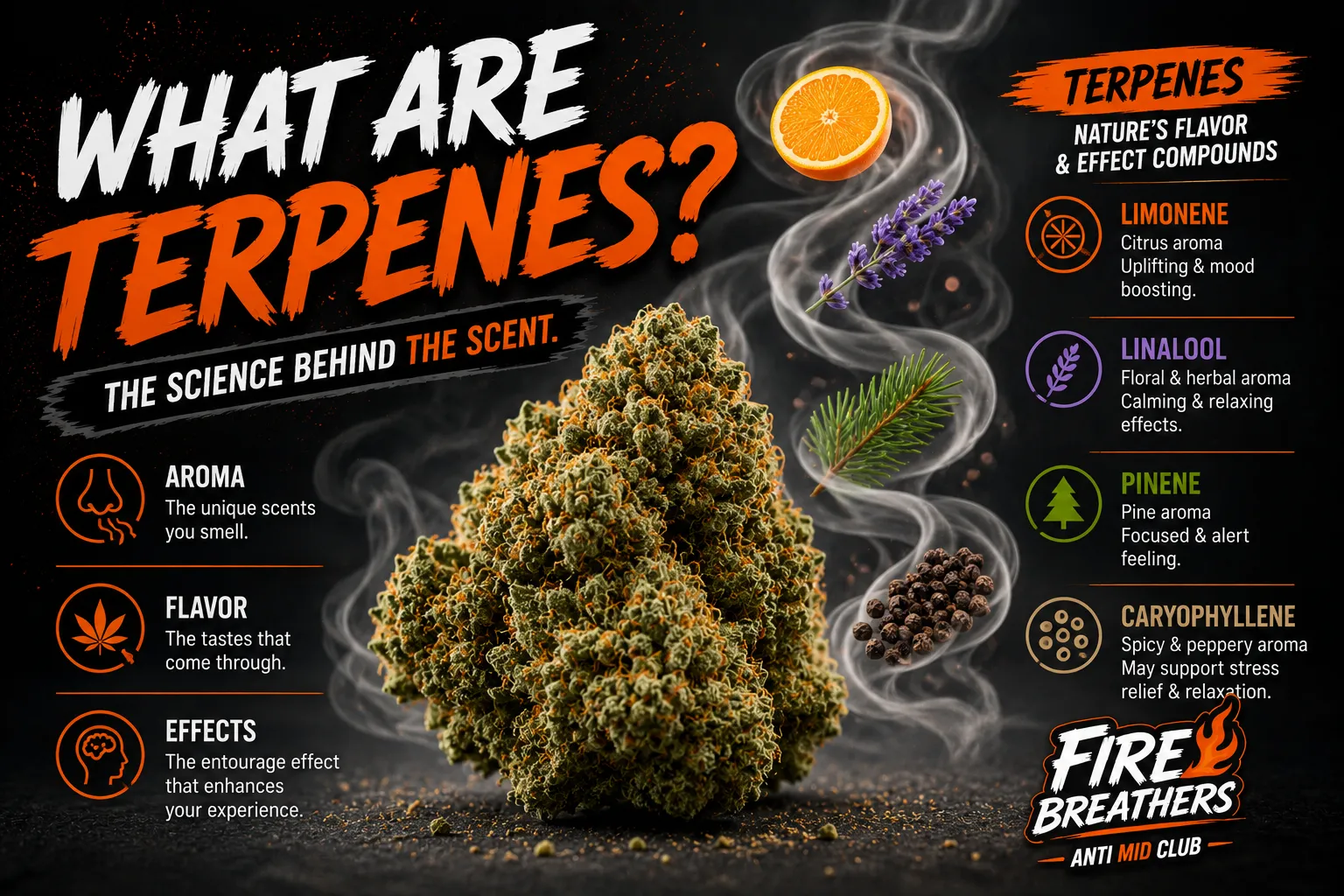
Terpenes are the aromatic compounds that give every cannabis strain its distinct smell, flavor, and character — the citrus snap of Lemon Cherry Gelato, the gas of Sour Diesel, the dessert-like sweetness of White Runtz. They’re not unique to cannabis (lavender, hops, pine trees, and citrus peels all produce them), but in cannabis they do something special: they shape how the cannabinoids feel. Two strains can test at the same THCA percentage and produce radically different experiences — and the terpene profile is the reason why. If you’ve ever wondered why one eighth hits like a freight train and another like a slow-rolling wave, terpenes are the answer.
That’s the short version. Below: what terpenes actually are, the eight most common ones in cannabis, how they shape the high, and why a 22% terpene-rich flower will beat a 32% terpene-flat flower every time.
Skip the science, shop terpene-rich craft flower → firebreathersca.com
The Quick Breakdown
| What they are | Aromatic organic compounds produced by plants — including cannabis — primarily in the trichomes. |
|---|---|
| What they do | Shape aroma, flavor, and (in combination with cannabinoids) the character of the high. |
| Where they live | Inside the same sticky resin glands (trichomes) that produce THCA, CBD, and other cannabinoids. |
| Why they matter | They’re the difference between flat, “just gets you stoned” flower and the connoisseur experience. |
| How they’re measured | Listed by percentage on a Certificate of Analysis (COA), usually as a terpene panel. |
| How to preserve them | Cool, dark, sealed storage. Heat, light, and air destroy them. |
What Are Terpenes, Exactly?
Terpenes are aromatic compounds produced by plants — the molecules responsible for what you smell when you crack open a jar of fresh flower, peel an orange, crush a pine needle, or rub a lavender leaf between your fingers. They exist all over the natural world. There are an estimated 20,000+ terpenes across plant life. Cannabis produces somewhere between 100 and 200 of them, with a couple dozen showing up in meaningful quantities.
In the cannabis plant, terpenes are produced inside the same sticky resin glands — trichomes — that produce THCA, CBD, and the other cannabinoids you’ve heard about. When you look at a quality bud under magnification and see those frosty, mushroom-shaped crystals, you’re looking at terpene factories.
That’s why “frosty” flower isn’t just a visual thing. Visible trichome density is a rough proxy for cannabinoid and terpene content. The more trichomes, the more of everything that makes flower worth smoking.
What Do Terpenes Actually Do?
Three jobs:
1. Aroma
Terpenes are the smell. When you open a jar and get hit with citrus, pine, gas, dessert, herb, or earth — that’s the terpene profile announcing itself. Cannabinoids like THCA are essentially odorless on their own.
2. Flavor
The same compounds that produce the aroma carry through to the flavor on the inhale and exhale. A flower heavy in limonene tastes bright and citrusy. A flower heavy in myrcene tastes earthy and herbal. A flower heavy in caryophyllene leans peppery and spicy.
3. Effects (the “Entourage Effect”)
This is the part most shoppers don’t know about. Terpenes don’t just smell and taste — they appear to influence how the cannabinoids feel. The same dose of THC paired with different terpene profiles produces noticeably different experiences. This synergy is called the entourage effect, and it’s why strain selection matters as much as potency.
A strain heavy in myrcene (mango-like, musky) tends to push toward the heavy, body-locked, “couch-stuck” experience people associate with classic indicas. A strain heavy in limonene (citrus) tends to feel lighter, more uplifting, more cerebral. A strain heavy in pinene (pine) often comes through clearer-headed and more focused.
The cannabinoid is the engine. The terpene profile is the steering wheel.
The 8 Most Common Cannabis Terpenes (And What Each One Feels Like)
These are the terpenes you’ll see most often on a terpene panel — and the ones that shape the experience the most.
Myrcene
- Aroma: Earthy, musky, ripe mango, clove
- Also found in: Mangoes, hops, lemongrass, thyme
- Typical character: Heavy, sedating, body-forward
- Strains: Many classic indicas — Granddaddy Purple, OG Kush lineage, Animal Cookies, Zkittles
Myrcene is usually the most abundant terpene in cannabis. If a flower smells “weedy” in the classic, dank, fresh-cut-grass-and-fruit way, myrcene is doing most of the talking. It’s the terpene most associated with the heavy, couch-locking, eyelid-dropping side of cannabis.
Limonene
- Aroma: Bright citrus, lemon, orange peel
- Also found in: Lemon rinds, orange peels, juniper, peppermint
- Typical character: Uplifting, mood-elevating, mentally bright
- Strains: Lemon Cherry Gelato, Super Lemon Haze, Wedding Cake, Do-Si-Dos
Limonene is the lift. When a flower smells lemony, candy-citrus, or like a freshly zested orange, that’s limonene. Limonene-dominant strains tend to feel social, upbeat, and clear-headed — they’re the strains people reach for in the afternoon or before a creative session.
Pinene
- Aroma: Fresh pine, rosemary, forest floor
- Also found in: Pine needles, rosemary, basil, conifer trees
- Typical character: Alert, clear-headed, focused
- Strains: Jack Herer, Blue Dream phenotypes, Strawberry Cough
Pinene is the terpene that tends to cut through the “stoned haze.” Strains with a strong pinene presence often feel sharper, more functional, and less foggy than their THC content would suggest. It’s often cited as the terpene that may help offset some of the short-term memory effects of THC, though the science is still developing.
Caryophyllene (Beta-Caryophyllene)
- Aroma: Black pepper, spice, warm wood
- Also found in: Black pepper, cloves, cinnamon, hops
- Typical character: Warming, relaxing, body-soothing
- Strains: Gorilla Glue (GG4), Original Glue, Bubba Kush, Girl Scout Cookies
Caryophyllene is unique because it actually binds to one of your endocannabinoid receptors (CB2) — meaning it interacts with your body the way a cannabinoid does, not just the way an aromatic compound does. It’s often associated with the warm, body-soothing, “good ache” relief that some cannabis users describe.
Linalool
- Aroma: Lavender, soft floral, sweet herbal
- Also found in: Lavender, mint, cinnamon, coriander
- Typical character: Calming, mellow, relaxing
- Strains: Lavender, LA Confidential, Granddaddy Purple, Kosher Kush
Linalool is the chill terpene. The same compound that makes lavender relaxing to smell shows up in cannabis strains people reach for at the end of the day. It’s almost never the dominant terpene, but when it’s present, it shapes the strain into something noticeably softer.
Humulene
- Aroma: Earthy, woody, hoppy, slightly bitter
- Also found in: Hops, sage, ginseng, ginger
- Typical character: Grounding, mellow, less appetite-stimulating than myrcene
- Strains: Sour Diesel pheno, Headband, Pink Kush
Humulene is the terpene that makes some old-school strains smell like a brewery. Hop-forward, earthy, with a bite. It tends to be a supporting terpene rather than a dominant one, but it shapes the overall character — usually pulling toward grounded and mellow.
Terpinolene
- Aroma: Fresh, complex, fruity-floral-herbal all at once
- Also found in: Nutmeg, cumin, apples, lilacs, conifers
- Typical character: Bright, uplifting, edgy in the best way
- Strains: Jack Herer, Dutch Treat, Ghost Train Haze, XJ-13
Terpinolene is the terpene that makes a strain smell interesting — the kind of bouquet that’s hard to put your finger on. It’s relatively rare as a dominant terpene, which is why terpinolene-forward strains often feel distinctive and stand out from the pack.
Ocimene
- Aroma: Sweet, herbal, mango, fresh tropical
- Also found in: Mint, parsley, basil, mangoes, orchids
- Typical character: Uplifting, energetic, slightly sweet
- Strains: Strawberry Cough, Clementine, Dream Queen, Golden Goat
Ocimene is the sweet-tropical note in a lot of fruity sativas and hybrids. It’s not usually the loudest terpene in the room, but when a flower has that mango-meets-mint sweetness on top of the more obvious notes, ocimene is doing the lifting.
Why Terpenes Matter More Than THCA Percentage
This is the single most important takeaway in this guide.
A high-terpene 22% THCA flower will outperform a low-terpene 32% THCA flower every single time. Connoisseurs know this. Most shoppers don’t.
Here’s why:
- Terpenes shape the experience. Same cannabinoid, different terpene profile, different high.
- Terpenes signal quality. A flower that lost its terpenes during cultivation, curing, or storage is a flower that wasn’t handled well. The cannabinoid number on the jar can still read high; the experience will still be flat.
- The nose knows. When you open a jar of premium flower and the aroma fills the room, that’s the terpene profile telling you it’s alive. When a jar opens and smells like nothing — or worse, like grass clippings or hay — the terpenes are gone, and so is most of the magic.
- Potency without terpenes is just numbness. High-THC flat-terpene flower gets you stoned in a heavy, dull way. High-THC terpene-rich flower gets you stoned in a specific way — the way the strain was bred to feel.
If you’re shopping by the number on the jar, you’re shopping wrong. Shop by aroma and terpene profile first, potency second.
For the full framework, see: How to Choose THCA Products
How to Read a Terpene Panel on a COA
A quality COA (Certificate of Analysis) will include a terpene panel alongside the cannabinoid panel. Here’s how to make sense of it:
| What to look at | What it tells you |
|---|---|
| Total terpene percentage | The sum of all detected terpenes. Quality craft flower usually lands between 2% and 4%. Above 3% is excellent. Below 1% is flat. |
| Dominant terpene | The largest single terpene by percentage. This drives the strain’s primary character. |
| Top 3 terpenes | The aromatic personality. A flower with myrcene + limonene + caryophyllene leading will smell and feel very different from one with terpinolene + ocimene + pinene. |
| Number of terpenes detected | More is usually better. Rich, complex profiles indicate fresh, well-cultivated flower. |
If a vendor publishes a terpene panel at all, that’s a sign they care. Most don’t bother. The ones that do are usually the ones worth buying from.
For the deeper breakdown on COA literacy, see: THCA Percentage Explained
What Destroys Terpenes (And How to Protect Them)
Terpenes are volatile compounds — meaning they evaporate easily. They’re also fragile. Three things kill them:
Heat
Heat is terpenes’ enemy number one. Storing flower above ~70°F slowly cooks the terpene profile out of it. Leaving a jar in a hot car will flatten it in days.
Light
UV light breaks down terpenes (and cannabinoids). Clear glass jars on a sunny shelf are a slow death sentence for terpene content. Dark glass, mylar bags, or opaque storage is the standard.
Air
Oxygen oxidizes terpenes. Every time you open a jar, you lose a little. Tight-sealed containers, opened only when you’re packing a bowl, are how you preserve the profile.
The fix: Cool, dark, sealed. A glass jar (preferably dark or kept in a drawer), at room temperature or slightly below, opened only when needed. Done right, premium flower holds its terpene profile for 6–12 months.
Terpenes vs. Synthetic “Botanical Terps”
A note of caution, especially around vapes and infused products.
Real terpenes — the ones extracted from cannabis or other plants in their native form — are what you want. Many low-end vape carts and infused products use synthetic terpenes or botanical isolates to mimic the aroma and flavor of real strains. They smell loud, often artificially loud, but they don’t carry the full character of the real thing.
How to tell the difference:
- Real terpenes: Listed as “cannabis-derived terpenes,” “live rosin,” “solventless,” or with a specific strain origin
- Synthetic terpenes: “Natural flavoring,” “botanical terpenes,” “terpene blend,” or no disclosure at all
If you can taste plastic, chemicals, or anything that screams “candy lab” rather than “growing plant,” you’re tasting synthetics. Walk.
When Terpene Knowledge Actually Helps You Shop
You don’t need to memorize every terpene. But knowing the basics helps you:
- Pick strains by aroma instead of by name. Crack a jar. Trust your nose. Citrus = energetic. Earthy/musky = heavier. Pine/herbal = clearer. Sweet/floral = mellower.
- Skip “fake premium” flower. No aroma = no terpenes = no experience. Doesn’t matter what the percentage says.
- Match terpene profile to the moment. Limonene-forward in the afternoon. Myrcene-forward in the evening. Pinene-forward when you need to focus. Linalool when you need to wind all the way down.
- Spot quality vendors. Anyone publishing terpene panels and naming dominant terpenes is operating at a higher standard than the bulk-flower middle of the market.
Why Fire Breathers Cares About Terpenes
We sell flower we’d smoke ourselves. That’s not a marketing line — it’s the entire reason the brand exists.
If we wouldn’t open the jar at home and want to roll one immediately, we don’t put it in the catalog. And the test of whether a flower passes that bar is almost always the aroma when the jar opens.
- Small batch. Big flavor. — terpene-forward genetics, every drop
- Craft indoor. — climate-controlled cultivation that protects terpene expression
- Hand-trimmed, hand-rolled. — no machine handling that beats up the trichomes
- Lab-tested every batch. — COAs available on request, including cannabinoid profile
- Free shipping over $40. — packaged to preserve freshness in transit
- Pressed to perfection. — for people who notice the difference
Shop terpene-rich craft THCA flower → firebreathersca.com
Frequently Asked Questions
What are terpenes in simple terms?
Terpenes are the aromatic compounds that give plants — including cannabis — their distinct smells and flavors. In cannabis, they also shape how the high feels, working alongside cannabinoids like THCA and THC to create the character of each strain.
Do terpenes get you high?
No. Terpenes are not intoxicating on their own. But they shape the character of the high produced by cannabinoids — making the same dose of THC feel uplifting, sedating, focused, or mellow depending on the terpene profile present.
Are terpenes only in cannabis?
No. Terpenes exist throughout the plant kingdom. Limonene is in lemon peels. Pinene is in pine trees. Linalool is in lavender. Cannabis just happens to produce a particularly rich and varied terpene mix in its trichomes.
What’s the most common terpene in cannabis?
Myrcene is the most abundant terpene in most cannabis strains. It’s earthy, musky, mango-like, and tends to push strains toward the heavier, more sedating end of the spectrum.
Which terpenes are best for sleep?
Strains rich in myrcene and linalool are most often associated with relaxation and sleep-friendly effects. Indica and indica-leaning hybrid genetics tend to lean this way.
Which terpenes are best for focus or daytime use?
Pinene, limonene, and terpinolene are most often associated with clear-headed, uplifting, daytime-friendly experiences. Sativa-leaning hybrids often feature these terpenes prominently.
What’s the “entourage effect”?
The entourage effect is the theory that cannabinoids and terpenes work synergistically — meaning the combined experience of all the compounds in a strain is greater than (and different from) what any single compound would produce alone. It’s the scientific basis for “strain matters more than percentage.”
How do I know if a flower has good terpenes?
Open the jar. Stick your nose in. If the aroma is loud, complex, and specific to the strain (lemon, gas, candy, pine, herb, dessert), the terpenes are intact. If it smells like nothing or like dry grass, the terpenes are gone — and so is most of the experience.
Are “live resin” and “live rosin” higher in terpenes?
Yes. Live resin and live rosin are extracted from fresh-frozen flower (rather than dried/cured flower), which preserves a much higher percentage of the original terpene profile. That’s why they taste so much more vivid than standard extracts.
Do terpenes affect flavor when you smoke or vape?
Absolutely. Terpenes are what you taste on the inhale and exhale. A high-terpene flower tastes like the strain — citrus, gas, cookies, pine, dessert. A low-terpene flower tastes like burnt plant matter. The terpenes are the flavor.
How long do terpenes last in flower?
Stored properly (cool, dark, sealed), terpenes hold up reasonably well for 6–12 months. Stored badly (warm, sunlit, exposed to air), they can flatten significantly in weeks.
The Bottom Line
Terpenes are the difference between flower that’s just flower and flower that’s actually worth smoking. They’re the aroma when you open the jar, the flavor on the exhale, and a big part of why one strain feels different from another even at the same potency.
If you’re shopping by THCA percentage alone, you’re missing the point. Shop by aroma. Shop by strain. Shop by the terpene profile on the COA. The number on the jar is one piece of the puzzle — and not the most important one.
Quality flower smells alive. Trust your nose.
Shop Fire Breathers — Small Batch. Big Flavor. Pressed to Perfection. →
Fire Breathers products are intended for adults 21 and older. Federally compliant hemp under the 2018 Farm Bill. Educational content — not medical advice. Comply with all applicable state and local laws.