
Quick Answer
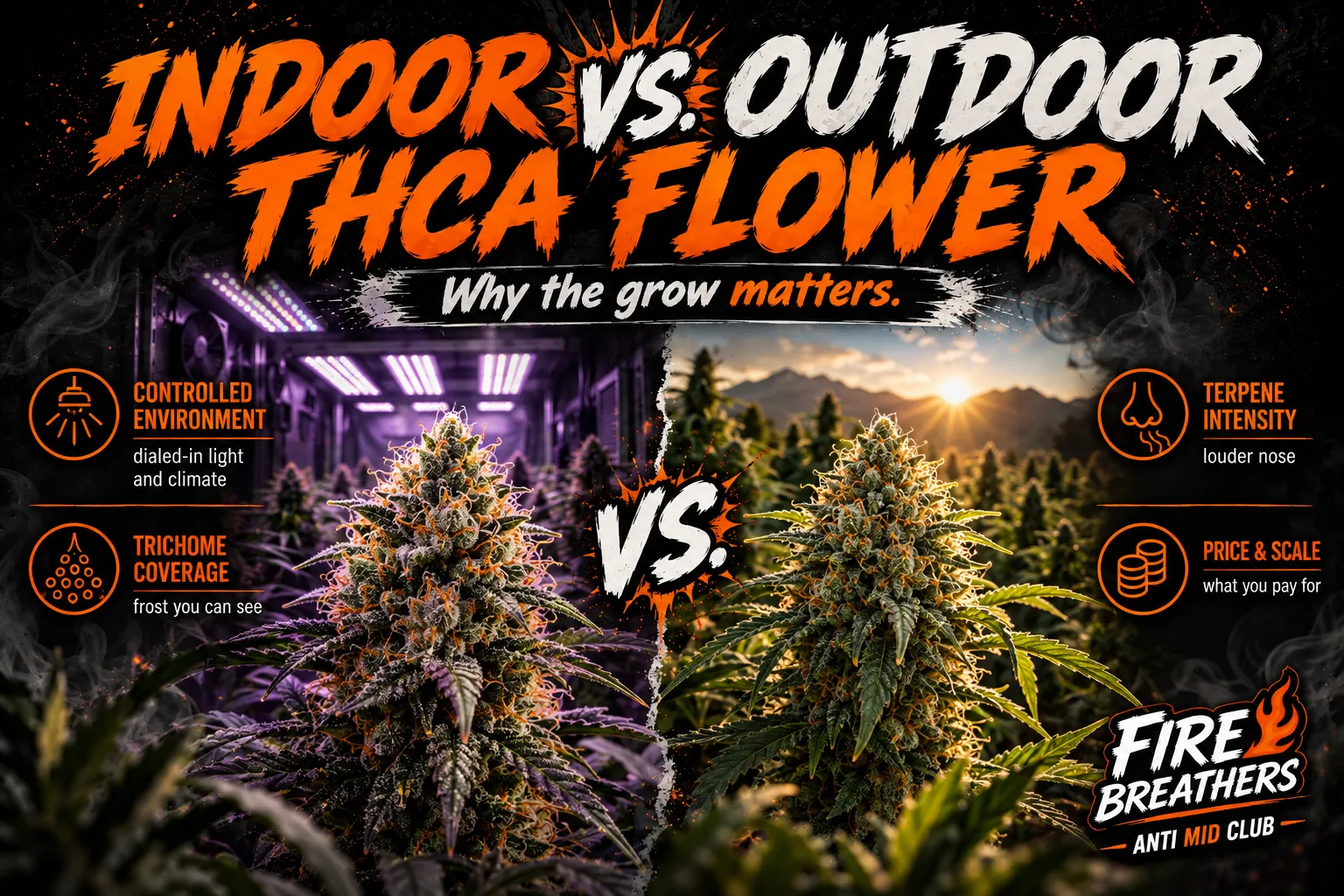
Indoor THCA flower is grown under artificial lights in a controlled room, which typically produces denser, frostier buds with louder aroma and more batch-to-batch consistency. Outdoor flower is grown in the sun, costs less to produce, and varies more with weather. Greenhouse and light-dep flower sit in between. Indoor costs more because control costs more.
All three can be legitimate. The problem is when outdoor flower is sold with indoor language and indoor prices. Below: how each method works, a side-by-side comparison, and how to tell what you’re actually buying.
Skip the reading and shop indoor-grown THCA flower → firebreathersca.com
The Quick Breakdown
| Indoor | Greenhouse / Light-Dep | Outdoor | |
|---|---|---|---|
| Light source | Artificial grow lights | Sun, often with supplemental lights and blackout tarps | Sun only |
| Climate control | Full: temperature, humidity, airflow | Partial | None |
| Harvests per year | Several, year-round | Often two or more | Usually one |
| Bud structure | Dense, tight, frosty | Moderately dense | Larger, often looser |
| Aroma / terpenes | Typically the loudest and most consistent | Can be strong; varies by operation | Varies widely by season |
| Consistency batch to batch | High | Medium | Lower |
| Pest and contaminant exposure | Lowest | Moderate | Highest |
| Cost to produce | Highest | Middle | Lowest |
| Shelf price | Premium | Mid-range | Budget |
How Indoor THCA Flower Is Grown
Indoor cultivation happens in sealed rooms where the grower sets every variable:
- Light. High-intensity grow lights on a precise schedule. Switching the schedule triggers flowering on the grower’s timeline, not the season’s.
- Climate. Temperature, humidity, and airflow are dialed in for each stage of growth, then adjusted again for drying and curing.
- Feeding. Water and nutrients are measured and consistent.
- Isolation. Walls keep out wind, rain, dust, wildfire smoke, and most pests.
What indoor gets you
- Bag appeal. Dense, symmetrical buds heavily coated in trichomes.
- Terpene intensity. Controlled conditions, especially a cool, steady environment late in flower and during the dry and cure, help protect volatile terpenes.
- Consistency. The same strain from the same grower tends to look, smell, and smoke the same from one batch to the next.
- Year-round fresh harvests. No waiting for the fall.
The trade-off
Indoor is expensive. Electricity, HVAC, dehumidifiers, lighting, and real estate all go into every gram. That’s why indoor sits at the top of the price range everywhere cannabis is sold.
How Outdoor THCA Flower Is Grown
Outdoor hemp is planted in the ground or in large containers and grown under the sun, usually with one harvest in the fall.
What outdoor gets you
- Lower price. The sun is free. Outdoor flower is the budget tier for a reason.
- Big plants and big yields. Full-season plants can be enormous.
- Lower energy footprint. No grow lights, no HVAC.
- Some genuinely good flower. Skilled outdoor farmers in good climates can grow flavorful, well-cured flower. Outdoor is not automatically bad.
The trade-offs
- Weather decides a lot. Heat waves, early rain, wind, and smoke all affect the crop.
- Exposure. Outdoor plants face insects, mold pressure, dust, and whatever is in the surrounding air and soil. That’s why a full contaminant panel on the COA matters even more here.
- Looser buds. Outdoor flower is often larger and airier, with less visible frost.
- Variation. One harvest can look and smell quite different from the last.
- Processing. Large outdoor harvests are often machine-trimmed, which can knock trichomes off.
Greenhouse and Light-Dep: The Middle Ground
Greenhouses use the sun as the main light source but add structure and some control.
Standard greenhouse
A covered structure that shields plants from rain and wind, often with fans, vents, shade cloth, and supplemental lighting. It’s cheaper than indoor and more controlled than open-field outdoor.
Light deprivation (“light-dep”)
Light-dep growers pull blackout tarps over the greenhouse or plants at set times each day. Shortening the “day” tricks the plants into flowering early, which lets a farm:
- Harvest more than once a year, rather than waiting for fall.
- Finish before bad weather, avoiding late-season rain and mold pressure.
- Time the harvest to hit the market with fresher product.
Well-run light-dep can produce flower that rivals some indoor. Poorly run greenhouses can produce flower that looks a lot like average outdoor. The label “greenhouse” alone doesn’t tell you which one you’re getting, so the COA, photos, and price have to do the talking.
Does Growing Method Change Potency?
Not as much as people assume. Genetics set the ceiling for THCA content; the environment determines how close the plant gets to it. Indoor flower often tests higher because conditions are tuned for the plant, but well-grown greenhouse or outdoor flower can test in the same range.
What changes more noticeably is terpene expression and presentation: how loud the jar is when it opens, how frosty the buds are, and how smooth the smoke feels. For many shoppers, those are the differences they actually notice in a session. (Related: THCA Percentage Explained and What Are Terpenes?)
How to Tell What You’re Actually Buying
The category’s biggest problem is labeling. Outdoor and greenhouse flower get sold as “premium” and “top-shelf” with no mention of how they were grown. Use these checks:
- It says “indoor” explicitly. If a listing doesn’t name the growing method, assume it isn’t indoor.
- Photos of the actual flower. Tight, frosty buds with visible trichomes. Stock images are a warning.
- A COA with contaminant screens. Pesticides, heavy metals, and microbials, not just potency. Learn the format in How to Read a THCA COA.
- Named strains. Real genetics you can look up, not “Premium Hybrid.”
- Price that makes sense. Indoor at outdoor prices is a contradiction. Someone is cutting a corner.
- Hand-trimmed. More common with smaller indoor batches, and better for trichome retention.
Red flags
- “Indoor quality” or “indoor-like” (not the same as indoor)
- No growing method listed anywhere
- Bulk pricing on “exotic” strains
- Loose, leafy buds in the photos
Indoor or Outdoor: Which Should You Buy?
Choose indoor if flavor, aroma, and bag appeal are why you buy flower. If you treat a session as the main event, indoor is the tier built for it.
Choose light-dep or greenhouse if you want a balance of quality and price and the vendor backs it up with photos and full COAs.
Choose outdoor if budget is the main factor, you plan to use the flower for things like infusing or making your own preparations, or you know and trust a specific outdoor farm.
Whatever you choose, demand that the growing method is stated honestly and the COA is available. For the full framework, see How to Choose THCA Products.
What Fire Breathers Grows
Fire Breathers flower is indoor-grown. That’s the only tier we carry. Our lineup includes candy-forward cuts like Zlushie THCA Flower (tropical citrus, creamy berries, sweet fruit candy), dessert profiles like Georgia Pie THCA Flower (ripe peach, buttery pastry, vanilla), and loud, layered cuts like Permanent Marker THCA Flower (sweet candy, creamy gas, floral funk, a touch of black pepper).
Every strain is $30 for 3.5g, $55 for 7g, or $100 for 14g.
Why Fire Breathers Flower
Most THCA flower on the market is outdoor or greenhouse sold with premium language. We went the other way:
- Small Batch. Big Flavor. Limited runs, not bulk harvests
- Indoor-grown California craft flower. Controlled light, climate, and cure
- Hand-trimmed, whole bud. Trichomes stay on the flower
- Third-party lab tested. COAs available, federal compliance verified
- Free shipping over $40 to most U.S. states
Frequently Asked Questions
Is indoor THCA flower better than outdoor?
For aroma, bag appeal, and consistency, indoor usually wins because the grower controls light, climate, and feeding. That doesn’t make all outdoor flower bad. Skilled outdoor farms can produce flavorful flower at a lower price. If flavor and presentation matter most to you, indoor is the safer bet. If price matters most, outdoor can make sense.
Why is indoor THCA flower more expensive?
Indoor cultivation runs on electricity, climate control, dehumidification, and dedicated real estate, and smaller indoor batches are more often hand-trimmed. All of that costs money. Outdoor uses free sunlight and grows larger plants. The price gap reflects real production costs, which is why indoor flower at outdoor prices deserves skepticism.
What is light-dep flower?
Light-dep, short for light deprivation, is a greenhouse technique where growers cover plants with blackout tarps for part of each day. The shorter “day” triggers flowering early, allowing multiple harvests per year and avoiding late-season weather. Quality ranges from close to indoor to close to outdoor, depending on the operation.
Is outdoor THCA flower less potent?
Not necessarily. Genetics set the ceiling for THCA content, and well-grown outdoor flower can test in a similar range to indoor. The bigger differences usually show up in terpene intensity, bud density, and consistency. Check the COA for actual numbers rather than assuming based on growing method.
How can I tell if THCA flower is indoor or outdoor?
Start with the listing: legitimate indoor growers say “indoor” plainly. Then look at photos of the actual product, with dense buds and heavy frost being typical of indoor. Check the price against the market and review the COA. Vague phrases like “indoor quality” usually mean the flower isn’t indoor.
The Bottom Line
Indoor, greenhouse, and outdoor are all real ways to grow good cannabis. They just land at different points on the quality, consistency, and price curve. Indoor buys you control, and control shows up in the jar.
Whatever tier you buy, insist on honesty: the growing method stated plainly, real photos, and a full COA.
Shop Fire Breathers Indoor THCA Flower — Small Batch. Big Flavor. →
Fire Breathers products are intended for adults 21 and older. Federally compliant hemp under the 2018 Farm Bill. Comply with all applicable state and local laws. Do not operate machinery while under the influence. Educational content — not medical or legal advice.