Quick Answer
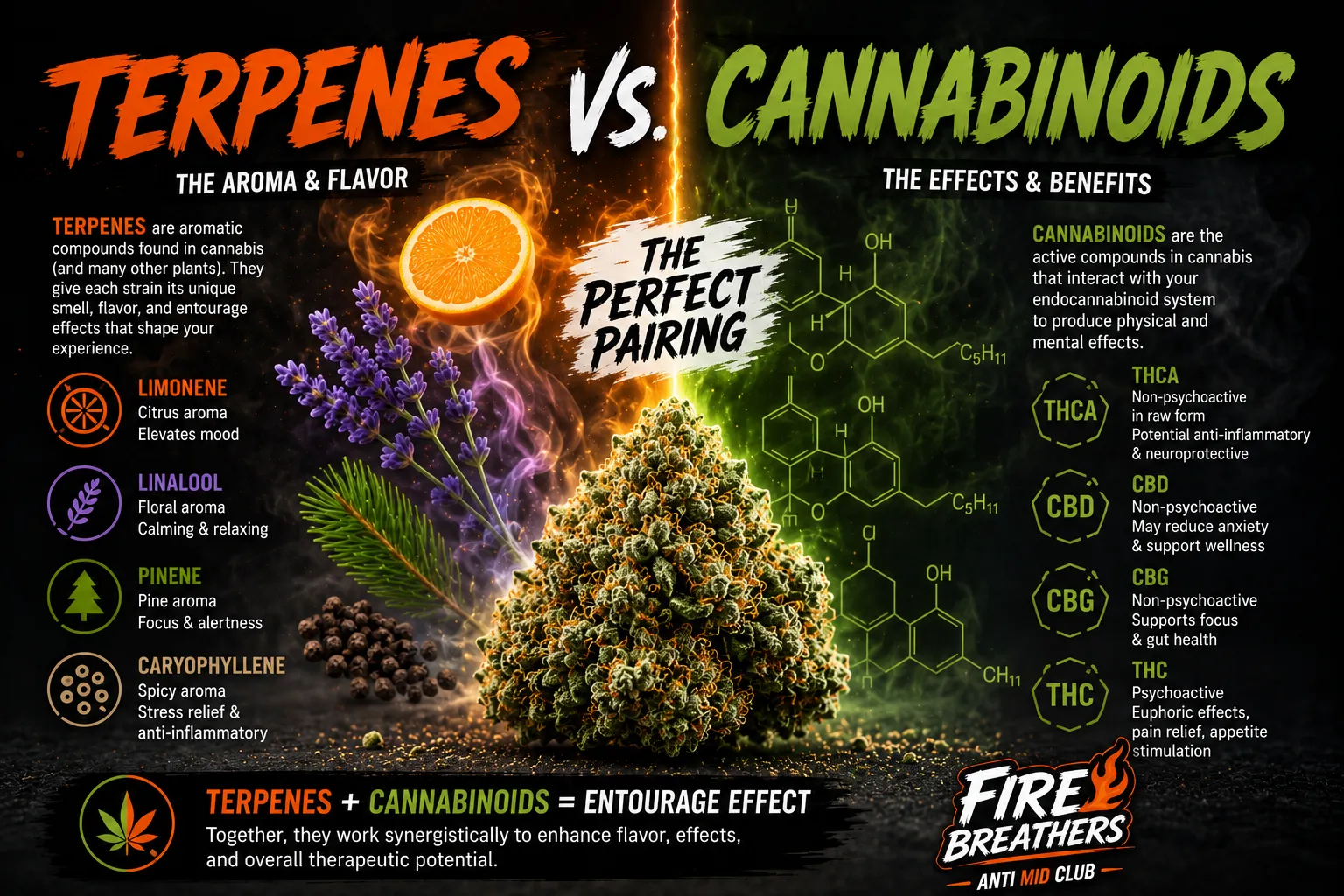
Cannabinoids (THCA, THC, CBD, CBG, and others) are the power — the compounds that produce intoxication and physiological effects. Terpenes are the character — the aromatic compounds that shape how those effects actually feel. Cannabinoids decide whether you get high. Terpenes decide how you get high. That’s why a 22% THCA flower with a rich, expressive terpene profile will consistently outperform a 32% THCA flower with no aroma. The number on the jar tells you the engine size. The terpene profile tells you what kind of car you’re driving.
If you’ve been shopping by THCA percentage alone, this is the article that changes how you buy flower. Read on.
Skip ahead and shop terpene-rich craft flower → firebreathersca.com
Terpenes vs. Cannabinoids: Full Comparison Table
| Factor | Cannabinoids | Terpenes |
|---|---|---|
| What they are | Active chemical compounds (THCA, THC, CBD, CBG, CBN, etc.) | Aromatic organic compounds (myrcene, limonene, pinene, caryophyllene, etc.) |
| Where they live | Trichomes of the cannabis plant | Same trichomes — they live together |
| Intoxicating? | THC and THCA (after heat) are. CBD and most others aren’t. | No — terpenes don’t get you high on their own. |
| What they do | Bind to endocannabinoid receptors. Produce the “high” and the physiological effects. | Produce aroma and flavor. Shape and modulate the cannabinoid experience. |
| Found outside cannabis? | Rarely — mostly cannabis-specific (with some exceptions like CBD) | Everywhere — lavender, citrus peels, pine, hops, mint, basil |
| What they smell/taste like | Essentially odorless | The entire aroma and flavor of the strain |
| How they’re measured | Percentage by dry weight on a COA | Percentage by dry weight, often as a terpene panel on a COA |
| What they signal | Potency | Quality, character, freshness, cultivation skill |
| Degrade over time? | Slowly | Quickly — heat, light, and air destroy them |
| Role in the experience | The engine | The steering wheel |
The One-Paragraph Version
Cannabinoids and terpenes are produced in the same place: the trichomes — those frosty, sticky resin glands on the surface of cannabis flower. They grow up together, get extracted together, and arrive in your jar together. Cannabinoids do the work of binding to your endocannabinoid system and producing intoxication. Terpenes do the work of shaping aroma, flavor, and the texture of the experience. Neither one is “better.” But if you only pay attention to cannabinoids, you’ll buy a lot of flat, boring, high-THC flower that gets you stoned in a dull, generic way. If you pay attention to both — and especially the terpenes — you’ll start buying flower that actually feels like something.
What Cannabinoids Do
Cannabinoids are the active compounds that interact with your endocannabinoid system — a network of receptors (CB1 and CB2) spread throughout your nervous system and body. When you consume cannabis, cannabinoids bind to those receptors and produce the effects you feel.
The major cannabinoids you’ll see on a COA:
- THCA (Tetrahydrocannabinolic acid) — The raw, non-intoxicating form found in living cannabis. Converts to Delta-9 THC when heated. The dominant cannabinoid in modern hemp flower.
- Delta-9 THC — The active, intoxicating form. What gets you high. Heated THCA becomes Delta-9 THC.
- CBD (Cannabidiol) — Non-intoxicating. Used in wellness products. Tends to mellow the THC experience when both are present.
- CBG, CBN, CBC — Minor cannabinoids found in smaller quantities. Each has its own profile and is the subject of growing research.
What cannabinoids decide: Whether you feel intoxicated, how strongly, how long, and at what dose. The cannabinoid panel on the COA is your potency map.
For the full breakdown: What Is THCA? and THCA vs. THC
What Terpenes Do
Terpenes are the aromatic compounds the same trichomes produce alongside cannabinoids. They’re what you smell when you open a jar. They’re what you taste on the inhale and exhale. And — this is the part most shoppers miss — they appear to shape how the cannabinoids feel.
This synergy is called the entourage effect: the theory that the combined effect of cannabinoids and terpenes is greater than (and qualitatively different from) what any single compound would produce in isolation.
A few examples of how terpenes change the texture of the high:
- Myrcene (earthy, mango, musky) → tends to push toward the heavy, body-locked, “couch-stuck” indica feel
- Limonene (citrus, bright) → tends to feel lighter, more uplifting, more cerebral
- Pinene (fresh pine) → tends to feel clearer, more focused, less foggy
- Caryophyllene (peppery, spicy) → tends to feel warm and body-soothing
- Linalool (lavender, soft floral) → tends to feel calming and mellow
Same cannabinoid. Different terpenes. Wildly different experience.
For the deep dive on individual terpenes: What Are Terpenes?
The Big Argument: Why a 22% Flower Can Beat a 32% Flower
This is the section worth re-reading.
For years, the hemp and cannabis market has trained shoppers to buy by THCA percentage. The number on the jar is the headline. Higher number = better flower. That’s how the conversation has been framed in dispensary menus, hemp brand websites, and reviews.
It’s mostly wrong.
A flower that tests at 22% THCA with 3.2% total terpenes and a complex, expressive profile (think: limonene-dominant, with caryophyllene and myrcene supporting) will:
- Smell louder when you open the jar
- Taste better through the entire smoke
- Produce a more specific effect — uplifting, mellow, focused, whatever the strain was bred to feel
- Feel more “alive” — closer to what real, fresh, premium cannabis feels like
A flower that tests at 32% THCA with 0.8% total terpenes and almost no detectable profile will:
- Smell flat, hay-like, or generic
- Taste like burnt plant matter
- Produce a generic, heavy, “just stoned” experience with no character
- Feel like a high without a personality
The 32% flower will technically get you more stoned. But you won’t enjoy it as much, and the experience won’t feel like anything specific.
Connoisseurs know this. Once you smoke enough flower, you can’t go back.
So Which One Matters More?
The honest answer: both matter, but most shoppers radically overweight cannabinoids and underweight terpenes.
If you have to pick a hierarchy, here’s how to think about it:
1. Aroma / Terpenes (Most Important)
If the jar opens and the room fills with aroma, you’re holding good flower. If it opens and smells like nothing — the rest doesn’t matter.
2. Strain & Genetics
The pedigree behind the flower. Real strains with real lineage (Lemon Cherry Gelato, White Runtz, Animal Cookies, Gorilla Glue, Zours) deliver predictable terpene profiles and predictable experiences. Mystery strains don’t.
3. Cultivation Quality
Indoor vs. outdoor, hand-trimmed vs. machine-trimmed, small-batch vs. bulk. Cultivation method shapes terpene preservation more than almost anything else.
4. Freshness
Even great flower goes flat if it sits too long. Fresh-harvest, properly cured, properly stored flower keeps its terpenes intact.
5. Cannabinoid Percentage
Then you look at the THCA number — and once you’re already buying terpene-rich, well-grown flower, you’ll rarely see anything below 20% anyway. The percentage tells you how strong the engine is, not how the car drives.
How to Read a COA Like a Connoisseur
A real COA gives you both panels. Here’s how to read them.
Cannabinoid Panel
- THCA % — primary potency indicator (modern craft flower: 20–32%)
- Delta-9 THC % — must be ≤0.3% by dry weight for federal hemp compliance
- Total THC % — what the flower would produce after full decarboxylation
- Minor cannabinoids — CBG, CBN, CBC etc., in smaller quantities
Terpene Panel
- Total terpene % — the sum of all detected terpenes. 2–4% is solid craft. Above 3% is excellent. Below 1% is flat.
- Dominant terpene — drives primary character
- Top 3 terpenes — the personality of the strain
- Number of terpenes detected — more is usually better (richer, more complex profile)
If a vendor doesn’t publish a terpene panel at all, that’s a tell. They might publish one on request. Or they might not have one — which means they’re either using a lab that didn’t run the panel, or they’re hiding a weak result. Neither is great.
For the broader COA literacy walk-through, see: THCA Percentage Explained
Practical Implications for How You Shop
Stop doing this:
- Picking the flower with the highest THCA number on the menu
- Assuming “33% THCA” is automatically better than “23% THCA”
- Skipping the aroma check because “the COA says it’s strong”
- Buying flower with no published terpene profile
- Treating cannabinoid potency as the whole story
Start doing this:
- Reading the full COA — cannabinoid panel AND terpene panel
- Opening every jar and trusting your nose
- Picking strain by aroma and terpene profile, then verifying with potency
- Choosing well-grown 22–28% flower over poorly-grown 30%+ flower
- Asking vendors which terpenes dominate a strain — and walking if they can’t answer
The Connoisseur’s Hierarchy
Here’s the framework experienced shoppers actually use:
| Priority | What You’re Evaluating | What to Look For |
|---|---|---|
| 1. Aroma | The jar test | Loud, specific, alive |
| 2. Terpene profile | COA terpene panel | 2%+ total, named dominants |
| 3. Strain pedigree | Genetics you can verify | Real names with real lineage |
| 4. Cultivation | How it was grown | Indoor, small-batch, hand-trimmed |
| 5. Freshness | When it was harvested | Recent harvest, properly cured |
| 6. Cannabinoid potency | THCA % on the COA | 20–32% sweet spot |
| 7. Federal compliance | Delta-9 on the COA | ≤0.3% by dry weight |
| 8. Vendor transparency | COAs, sourcing, reviews | Published openly, not hidden |
Notice where cannabinoid potency lands. Sixth. Not first.
Why This Matters in a Market That Lies About Numbers
Worth saying out loud: the THCA percentage on a jar isn’t always accurate.
The hemp flower market has a real and documented problem with potency inflation. Labs that competing growers use have different methodologies. Some vendors cherry-pick the highest-potency sample from a batch and put that number on every jar. Some round generously. Some just lie.
When you shop on percentage alone, you’re inviting that whole circus into your purchase decision.
When you shop on aroma + terpene profile + cultivation quality first — and use cannabinoid potency as a sanity check rather than the headline — you’re buying based on signals that are much harder to fake. A flower that smells alive and tests at 24% with 3% terpenes will beat a flower that “tests at 34%” but smells like dust, every single time.
Why Fire Breathers Is Built Around This Principle
Fire Breathers isn’t a numbers brand. We don’t put 33%+ stickers on jars. We don’t chase potency for marketing — and we don’t carry flower that wins on numbers but loses on aroma.
We source craft indoor flower from California growers because that’s where the terpene-forward genetics live. We sell strains you can actually look up — White Runtz, Lemon Cherry Gelato, Animal Cookies, Zkittles, Gorilla Glue, Zours — and rotating limited drops with phenotypes worth paying attention to.
- Small batch. Big flavor. — the flavor part is the whole point
- Craft indoor cultivation — climate-controlled to protect terpene expression
- Hand-trimmed, hand-rolled — no machines beating up the trichomes
- Lab-tested every batch — COAs on request, including the terpene panel
- Free shipping over $40 — packaged to preserve freshness in transit
- Built for connoisseurs — for people who can tell
Shop terpene-rich craft THCA flower → firebreathersca.com
Frequently Asked Questions
What’s the difference between cannabinoids and terpenes?
Cannabinoids (THCA, THC, CBD, etc.) are the chemical compounds that interact with your endocannabinoid system and produce the high. Terpenes are aromatic compounds that produce flavor and aroma — and shape how the high feels. Both live in the same trichomes on the cannabis plant, but they do very different jobs.
Do terpenes affect the high?
Yes — significantly. While terpenes aren’t intoxicating on their own, they modulate the character of the cannabinoid experience through what’s called the entourage effect. The same dose of THC with different terpene profiles produces noticeably different experiences (uplifting, sedating, focused, mellow, etc.).
Is THCA percentage the most important thing?
No. It’s one important thing, but aroma, terpene profile, strain genetics, and cultivation quality matter more for the actual experience. A 22% flower with a rich terpene profile will outperform a 32% flower with no aroma.
What’s a good total terpene percentage?
For modern craft hemp flower: 2–4% total terpenes is solid. Above 3% is excellent. Below 1% means the flower is flat and probably wasn’t grown, cured, or stored well.
Why does my flower smell strong but test low on THCA?
Because aroma is driven by terpenes, not cannabinoids. A flower can have a relatively modest THCA percentage and a massive terpene profile — and that combination often produces a more satisfying experience than high-THCA flower with no terpenes.
Can I get high from terpenes alone?
No. Terpenes aren’t intoxicating. They shape the character of the high produced by cannabinoids, but they don’t produce the high themselves.
What is the entourage effect?
The entourage effect is the principle that cannabinoids and terpenes work synergistically — meaning the combined effect of all compounds in a strain is more than (and qualitatively different from) any single compound on its own. It’s the scientific reason “strain matters” instead of just “potency matters.”
How do I know if a flower has good terpenes without a COA?
Open the jar. Stick your nose in. If the aroma is loud, complex, and specific to the strain (citrus, gas, dessert, pine, herb), the terpenes are intact. If it smells like nothing, dry grass, or hay — the terpenes are gone.
Do cannabinoids and terpenes degrade over time?
Both do, but terpenes degrade much faster. Cannabinoids hold up reasonably well for 12+ months if stored properly. Terpenes start flattening within weeks if exposed to heat, light, or air. Cool, dark, sealed storage matters.
Should I shop by indica/sativa or by terpene profile?
Terpene profile is more reliable than indica/sativa labels, which have become inconsistent across the modern hemp market. A “sativa” flower dominated by myrcene will still feel heavy. An “indica” flower dominated by limonene will still feel uplifting. The terpenes tell the truth.
The Bottom Line
Cannabinoids do the work. Terpenes give the work its character.
If you buy by THCA percentage alone, you’ll end up with strong, generic, dull-feeling flower. If you buy by aroma, terpene profile, and quality cultivation — and let cannabinoid potency be a sanity check, not the headline — you’ll start buying flower that’s actually worth smoking.
The connoisseur shift is simple: trust your nose more than the number on the jar.
Shop Fire Breathers — Small Batch. Big Flavor. Pressed to Perfection. →
Fire Breathers products are intended for adults 21 and older. Federally compliant hemp under the 2018 Farm Bill. Educational content — not medical advice. Comply with all applicable state and local laws.