Quick Answer
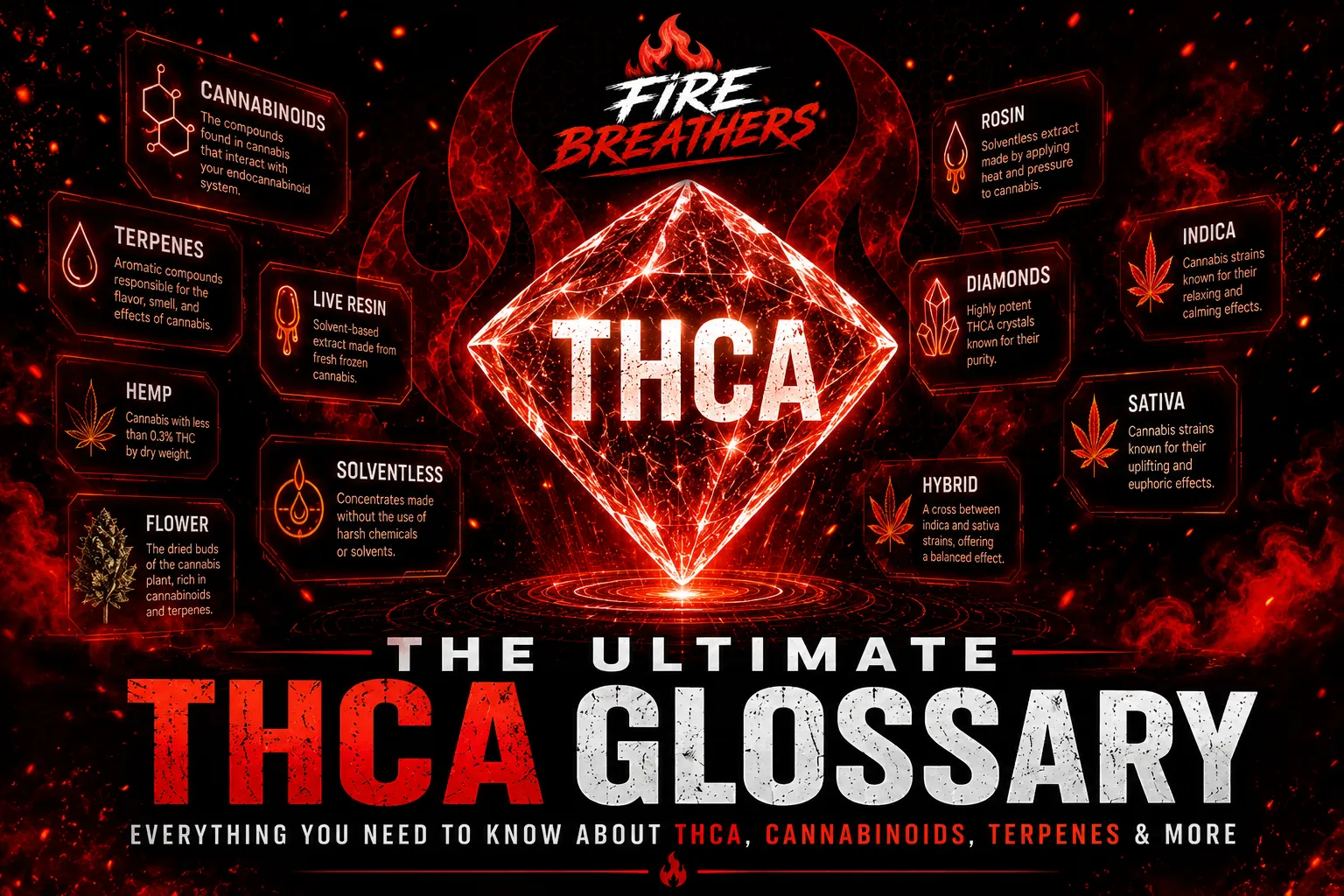
THCA shopping comes with its own language — eighths and zips, rosin and resin, full spectrum and broad spectrum, COAs and total THC. Most of it sounds more complicated than it is. This glossary breaks down 50+ of the terms you’ll actually run into when buying THCA flower, concentrates, vapes, and edibles. Every entry gets a precise technical definition and a plain-English translation, so you can read a label, a menu, or a lab report without guessing.
Bookmark this page. It’s built to be the one tab you keep open while you shop.
Skip the glossary, shop small-batch THCA flower → firebreathersca.com
How to Use This Glossary
Terms are grouped by category. Each entry has two lines:
- The technical definition — what it actually means.
- 🗣️ In plain English — the same thing, said the way a friend would explain it.
Jump to a section:
- 🌿 Flower & Plant Basics
- 💎 Concentrates & Extracts
- 💨 Vapes & Hardware
- 🍬 Edibles & Other Formats
- 📏 Measurements & Quantities
- 🧪 Potency & Lab Testing
- ⚖️ Legal & Compliance
- 🔬 Effects & Experience
Flower & Plant Basics
Flower (Bud)
The dried, cured, smokable part of the cannabis plant — the female plant’s resin-coated blooms. 🗣️ In plain English: The actual “nug” you smoke. When people say “flower,” they mean buds.
THCA
Tetrahydrocannabinolic acid — the raw, non-intoxicating acid found in living hemp and cannabis. Heat converts it into Delta-9 THC. 🗣️ In plain English: Raw THC. It won’t get you high until you heat it. Full breakdown here.
Trichomes
The tiny, frosty, mushroom-shaped resin glands on the surface of the flower. They produce cannabinoids and terpenes. 🗣️ In plain English: The sticky “crystals” on good bud. More frost usually means more potency and flavor.
Terpenes
Aromatic compounds produced in the trichomes that give each strain its smell, flavor, and character. 🗣️ In plain English: What you smell when you open the jar. They shape how the high feels, not just the scent. Deep dive here.
Strain (Cultivar)
A named genetic variety of cannabis with a consistent terpene and effect profile — like White Runtz or Lemon Cherry Gelato. 🗣️ In plain English: The “type” of weed by name. Like grape varieties for wine.
Indica / Sativa / Hybrid
A traditional way to categorize strains. Indica leans relaxing and body-forward, sativa leans uplifting and heady, hybrid blends both. 🗣️ In plain English: Indica = couch. Sativa = active. Hybrid = somewhere in between. Terpenes matter more than the label, though.
Indoor / Outdoor / Light-Dep
Cultivation methods. Indoor is grown in a climate-controlled room, outdoor is grown in open sun, light-dep (greenhouse) is a hybrid of both. 🗣️ In plain English: Indoor is the premium, terpene-rich stuff. Outdoor is cheaper and usually less potent and flavorful.
Cure / Curing
The slow, controlled drying and aging of harvested flower that develops flavor and smoothness over weeks. 🗣️ In plain English: The “resting” period after harvest. A good cure is the difference between harsh and smooth.
Frosty
Slang describing flower heavily coated in visible trichomes. 🗣️ In plain English: It looks like it’s dusted in sugar. Usually a good sign.
Concentrates & Extracts
Concentrate
An umbrella term for any product made by extracting and concentrating the cannabinoids and terpenes out of flower. 🗣️ In plain English: The “strong stuff.” Flower distilled down to its active parts.
Hash Rosin
A solventless concentrate made by pressing cannabis (or hash) with heat and pressure to squeeze out the resin. 🗣️ In plain English: Concentrate made with just heat and a press — no chemicals. The clean, premium option.
Live Rosin
Hash rosin pressed from flower that was fresh-frozen right after harvest instead of dried, preserving more terpenes. 🗣️ In plain English: Hash rosin’s tastier cousin. Frozen fresh = louder flavor.
Pure Rosin
Single-source rosin that hasn’t been blended, cut, or mixed with anything else. 🗣️ In plain English: Just the rosin, nothing added. No fillers, no blends.
Live Resin
A concentrate extracted from fresh-frozen flower using a solvent (usually butane). Different from rosin, which uses no solvent. 🗣️ In plain English: Frozen-fresh flavor, but made with a solvent instead of a press. Resin = solvent; rosin = no solvent.
Distillate
A highly refined cannabinoid oil stripped down to near-pure THC or THCA, usually with the natural terpenes removed. 🗣️ In plain English: Super-refined oil. Very potent, but flavorless unless terps are added back in. The cheap base for many carts.
Solventless vs. Solvent-Based
Solventless extraction uses only heat, pressure, ice, or water (rosin). Solvent-based uses chemicals like butane (BHO) or CO₂ (resin, distillate). 🗣️ In plain English: Solventless = nothing but mechanical pressing. Solvent-based = chemicals do the work. Connoisseurs prefer solventless.
Full Spectrum
A product that retains the complete range of cannabinoids and terpenes from the original plant. 🗣️ In plain English: The whole plant’s chemistry, kept intact. Fuller flavor, fuller effect.
Broad Spectrum
Full spectrum with one specific compound removed — usually most of the Delta-9 THC. 🗣️ In plain English: Almost the whole plant, minus one thing. Often used to keep THC very low.
Pure Spectrum (Isolate)
A single cannabinoid refined to 99%+ purity, with everything else removed. 🗣️ In plain English: One pure ingredient, nothing else. No entourage effect, no flavor — just the molecule.
Wax / Shatter / Badder / Diamonds
Different textures of concentrate. Wax is soft, shatter is glassy and brittle, badder is whipped and creamy, diamonds are crystalline THCA. 🗣️ In plain English: Same idea, different consistency. Texture is mostly preference — diamonds are the most potent-looking.
Dab / Dabbing
Vaporizing a small amount of concentrate on a heated surface and inhaling the vapor. 🗣️ In plain English: Smoking concentrate off a hot nail or coil. Strong — not a beginner move.
Vapes & Hardware
Disposable Vape
An all-in-one vape pen that comes pre-charged and pre-filled, used until empty and then thrown away. 🗣️ In plain English: Grab-and-go pen. No refilling, no separate battery. Use it up and toss it.
Cartridge (Cart)
A pre-filled oil tank that screws onto a separate, reusable battery. 🗣️ In plain English: The refill tank that twists onto a vape battery. “Cart” for short.
510 Thread
The universal screw-thread standard that connects most cartridges to most batteries. 🗣️ In plain English: The “standard plug” for vapes. If it’s 510, almost any battery fits it.
Ceramic vs. Cotton Coil
The heating element inside a vape. Ceramic coils tend to deliver cleaner flavor; cotton/wick coils are cheaper. 🗣️ In plain English: Ceramic = better taste, usually pricier. The part that actually heats the oil.
Pre-Roll / Joint / Blunt
Ready-to-smoke rolled flower. A joint uses rolling paper, a blunt uses a tobacco/hemp wrap, a pre-roll is any joint sold ready-made. 🗣️ In plain English: Already rolled for you. Joint = paper, blunt = wrap, pre-roll = bought ready to light.
Edibles & Other Formats
Edible
Any food or drink product infused with cannabinoids, taken by mouth instead of inhaled. 🗣️ In plain English: You eat it instead of smoking it. Slower to kick in, lasts longer.
Gummy
The most common edible format — a dosed, chewable candy infused with cannabinoids. 🗣️ In plain English: Cannabis candy. Easy to dose by the piece.
Hash Rosin Gummy
A gummy infused with solventless hash rosin instead of distillate, carrying a fuller cannabinoid and terpene profile. 🗣️ In plain English: The premium gummy. Made with real rosin, so it’s full-spectrum, not just flavored THC.
Tincture
A liquid extract taken under the tongue with a dropper for faster absorption than a typical edible. 🗣️ In plain English: Drops you hold under your tongue. Kicks in faster than a gummy.
Onset / Duration
Onset is how long until effects begin; duration is how long they last. Inhaled formats are fast and short; edibles are slow and long. 🗣️ In plain English: Onset = how fast it hits. Duration = how long it lasts. Edibles are slow-on, long-lasting.
Measurements & Quantities
Gram (g)
The base unit of weight for flower. Roughly the weight of a paperclip’s worth of bud. 🗣️ In plain English: The smallest standard amount. One gram = enough for a joint or two.
Eighth (1/8)
An eighth of an ounce — 3.5 grams of flower. 🗣️ In plain English: The most common purchase size. “Grab an eighth” = 3.5g.
Quarter (1/4)
A quarter of an ounce — 7 grams of flower. 🗣️ In plain English: Two eighths. 7 grams.
Half (1/2)
Half an ounce — 14 grams of flower. 🗣️ In plain English: Four eighths. 14 grams.
Ounce (oz / “Zip”)
A full ounce — 28 grams of flower. “Zip” is slang from the bag it used to fit in. 🗣️ In plain English: The big one. 28 grams. A “zip” is just an ounce.
Unit / Each
A single packaged item — one vape, one pre-roll pack, one jar of edibles — rather than a weight. 🗣️ In plain English: Priced per item, not per gram. One “unit” = one product.
Milligram (mg)
The dose unit for edibles, tinctures, and vapes — the amount of cannabinoid per serving. 🗣️ In plain English: How strong each piece is. A 5mg gummy is mild; a 25mg gummy is not.
Potency & Lab Testing
COA (Certificate of Analysis)
A third-party lab report verifying a product’s cannabinoid content, terpene profile, legal compliance, and safety screens. 🗣️ In plain English: The product’s report card from an independent lab. No COA = walk away.
Cannabinoid Panel
The section of a COA listing each cannabinoid detected and its percentage. 🗣️ In plain English: The list of “what’s in it and how much.” Where you confirm the THCA number.
Terpene Panel
The section of a COA listing detected terpenes and their percentages. 🗣️ In plain English: The flavor and aroma breakdown on the lab report. Most brands skip it — the good ones don’t.
THCA %
The percentage of THCA in the flower by dry weight. A common shorthand for potency. 🗣️ In plain English: The big number on the jar. Higher isn’t always better — terpenes matter too. Why here.
Total THC
A formula that combines existing Delta-9 THC with the Delta-9 that THCA will produce once heated. 🗣️ In plain English: The “real” THC number after you light it. This is the figure new federal rules will focus on.
Decarboxylation (Decarb)
The chemical reaction where heat strips a carboxyl group from THCA, converting it into active Delta-9 THC. 🗣️ In plain English: The science word for “heat turns THCA into THC.” It happens every time you light up.
Dry Weight
The measurement basis for legal THC limits — the product weighed with its moisture removed. 🗣️ In plain English: How the law measures potency: weighed dry, not fresh.
Legal & Compliance
2018 Farm Bill
Federal legislation that legalized hemp — defined as cannabis with ≤0.3% Delta-9 THC by dry weight. 🗣️ In plain English: The law that made hemp-derived THCA legal to ship. The reason this market exists.
Hemp-Derived
Sourced from cannabis that qualifies as federal hemp under the 0.3% Delta-9 threshold. 🗣️ In plain English: Comes from legal hemp, not marijuana — even though it can feel the same once heated.
0.3% Delta-9 Threshold
The federal line: at or below 0.3% Delta-9 THC by dry weight is hemp; above it is marijuana. 🗣️ In plain English: The legal cutoff. Stay under it and it’s federally legal hemp.
Compliant
Describes a product that meets the legal hemp threshold and testing requirements. 🗣️ In plain English: It’s within the rules. A compliant brand can prove it with a COA.
The Cannabinoid Family
The related compounds you’ll see on labels: Delta-8, Delta-9, THCA, HHC, CBN, CBG, and CBD — each with different effects and legal treatment. 🗣️ In plain English: THCA’s relatives. Some are intoxicating, some aren’t, and the law treats them differently. Compare THCA vs THC here.
Effects & Experience
Entourage Effect
The theory that cannabinoids and terpenes work together synergistically, producing an effect greater than any single compound alone. 🗣️ In plain English: The whole plant working as a team. It’s why full-spectrum often feels better than isolate.
Tolerance
The body’s reduced response to cannabinoids after repeated use, requiring more for the same effect. 🗣️ In plain English: The more you use, the more it takes. A break resets it.
Body High vs. Head High
A body high is a physical, relaxing sensation; a head high is cerebral and heady. Strain and terpenes determine which dominates. 🗣️ In plain English: Body high = you feel it in your limbs. Head high = you feel it in your thoughts.
Couch-Lock
A heavy, sedating, hard-to-get-up effect associated with strong indica or myrcene-rich strains. 🗣️ In plain English: Too relaxed to move. The classic heavy-indica feeling.
Microdose
Taking a very small, often sub-perceptual amount to get mild effects without significant intoxication. 🗣️ In plain English: A tiny dose for a light touch. Enough to take the edge off, not enough to feel “high.”
Why This Glossary Exists
Most of the THCA market counts on you not understanding the labels. Vague strain names, missing COAs, distillate dressed up as “premium” — confusion is how low-quality flower gets sold at premium prices.
Fire Breathers operates the other way. We sell craft indoor flower we’d smoke ourselves, and we’d rather you knew exactly what every term on the jar means before you buy.
- 🔥 Small batch. Big flavor. — terpene-forward genetics, every drop
- 🌱 Craft indoor. — no bulk outdoor, no mids
- ✋ Hand-trimmed, hand-rolled. — no machine handling
- 🧪 Lab-tested every batch. — COA on request, federal compliance verified
- 📦 Free shipping over $40. — ships legally to most U.S. states
🔥 Shop terpene-rich craft THCA flower → firebreathersca.com
Frequently Asked Questions
What does “eighth” mean when buying THCA flower?
An eighth means an eighth of an ounce, which equals 3.5 grams of flower. It’s the most common purchase size for flower. Two eighths make a quarter (7 grams), four make a half (14 grams), and eight make a full ounce (28 grams, also called a “zip”).
What’s the difference between rosin and resin?
The key difference is the extraction method. Rosin is solventless — made by pressing flower or hash with heat and pressure. Resin is solvent-based — made by extracting cannabinoids with a chemical like butane. Both can be “live” (from fresh-frozen flower), but rosin is generally considered the cleaner, more premium option.
What does full spectrum mean versus broad spectrum?
Full spectrum keeps the complete range of cannabinoids and terpenes from the plant, including trace Delta-9 THC. Broad spectrum keeps most of that profile but removes one compound — usually most of the Delta-9. Isolate (sometimes called pure spectrum) strips everything down to a single cannabinoid at 99%+ purity.
Why does a COA matter when buying THCA?
A Certificate of Analysis is a third-party lab report that verifies what’s actually in the product — cannabinoid potency, terpene content, Delta-9 compliance, and the absence of pesticides, heavy metals, and microbials. If a vendor can’t or won’t produce a COA, you have no way to confirm potency, legality, or safety.
Is a higher THCA percentage always better?
No. A terpene-rich flower at 22% THCA will usually outperform a terpene-flat flower at 32%. Terpenes shape the character and quality of the experience as much as raw potency does. Shop by aroma and terpene profile first, percentage second.
What’s the difference between distillate and hash rosin?
Distillate is a chemically refined oil stripped to near-pure cannabinoid, usually with terpenes removed and sometimes added back synthetically. Hash rosin is solventless, pressed directly from flower or hash, and retains the natural terpene profile. Rosin is the connoisseur’s choice; distillate is cheaper and more common in budget carts.
The Bottom Line
You don’t need to memorize all of this. But knowing the difference between rosin and resin, full spectrum and isolate, an eighth and a zip — that’s the difference between shopping confidently and getting talked into something you didn’t want.
Keep this page handy. When a label or a menu throws a term at you, you’ll have the translation.
🔥 Shop Fire Breathers — Small Batch. Big Flavor. Pressed to Perfection. →
Fire Breathers products are intended for adults 21 and older. Federally compliant hemp under the 2018 Farm Bill. Educational content — not medical advice. Comply with all applicable state and local laws.